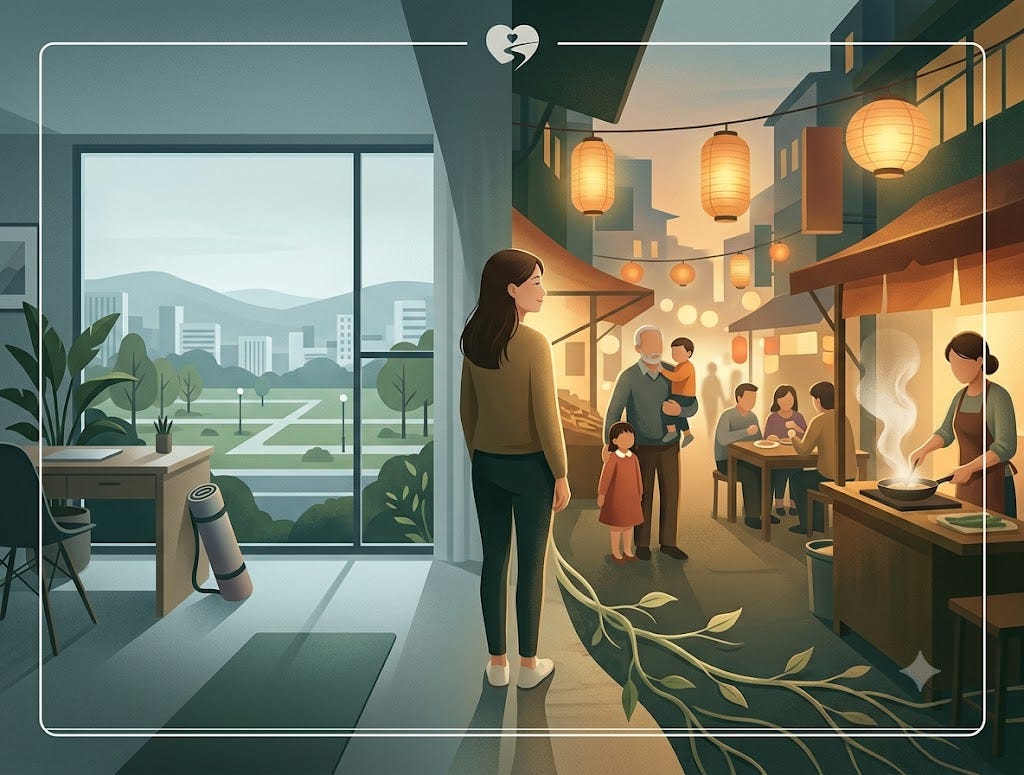
At the end of May, my husband and I took our five-year-old daughter and three-year-old son back to Asia for six weeks. We spent four weeks in Taiwan, then traveled to Shenzhen, hoping to see family and friends on both sides of the family.
Before we left, I had imagined the trip in so many ways. The food I missed, the relatives I had not seen for years—all of it seemed to be beckoning to us from across the Pacific.
What I had not expected was that the first to register this return “home” would not be memory, but the body.
Soon after we arrived in Taiwan, the dyshidrotic eczema on my fingers returned right on schedule.
At first, there were only a few clear blisters, as though my body were making a mild complaint about the heat and humidity. By the second week, the protest had abruptly escalated. A mysterious rash spread up both legs and eventually reached my neck. One night, the itching dragged me violently out of sleep again and again. It felt as though countless tiny insects were gnawing beneath my skin.
The doctor in the urgent care wrote “urticaria”—hives—on the diagnosis sheet. The cause might have been something I had eaten, or something unfamiliar my body had come into contact with.
Of course, I could not prove that it had anything to do with the exhaustion and tension of those weeks. But the eruption was so fierce that it was difficult not to make the connection: everything around me seemed to have exceeded the load my body was accustomed to carrying.
My hair, too, lost all sense of order.
In the United States, I could blow-dry it carelessly after a shower and it would remain more or less smooth. In Taiwan, the southern humidity seemed to have a will of its own. The moment my hair was dry, it curled, swelled, and sprang outward, like a disheveled, furious animal.
Every few days, I went to a salon and asked the stylist to straighten it section by section with a round brush and hair dryer. When I tried to do it myself, I would spend what felt like forever holding the dryer over my head, my face and neck slick with sweat, only to find that the hair in the mirror was still stubbornly jutting out in every direction.
It was only hair, and yet I often found myself standing in front of the mirror, seized by a shapeless anger.
Only later did I realize that I was not truly angry about how I looked. I was angry because I seemed to have lost the ability to maintain the ordinary order of my life. Things I had long stopped having to think about in the United States had to be relearned and readjusted to here, demanding effort all over again.
My skin was protesting. My hair was out of control. In its almost theatrical way, my body was reminding me that returning to a familiar place did not mean everything there would still feel familiar.
The heat, the humidity, the mosquitoes, and the long meiyu season—the humid early-summer rains of East Asia—also stretched ordinary moments of parenting to their limits.
One afternoon, my daughter and son began fighting over a toy again. They stood on opposite sides of the living room, screaming at each other, neither willing to let go. I pressed my fingers wearily to my temples. I knew exactly what I was supposed to do: crouch down, listen, empathize, mediate. But I could not squeeze out one more drop of patience.
Just as I was preparing to force myself into the conflict, A-gong—the children’s grandfather—asked casually from across the room:
“Who wants to go for a walk and feed the turtles?”
The two children, who a moment earlier had been ready for battle, stopped at once.
“Me!” they shouted together.
Within a minute, they had put on their shoes and were scampering out the door behind him.
I stood in the doorway and watched A-gong walking ahead, my daughter and son trailing after him like two excited ducklings. A sudden warmth rose in my chest.
In the United States, moments like this are usually ours alone to absorb. No matter how tired we are, someone has to settle the children’s quarrels; someone has to catch and hold their emotions. But here, when I was nearly spent, a pair of hands would reach out as naturally as if it were nothing, lead the children away, and gently pull me back from the edge of snapping.
What home gives us is not only familiar language and food. It is also the long-forgotten feeling that the burden of living is shared.
My body was clearly rejecting the climate here. And yet, held up by the people who loved us, life was slowly acquiring a different kind of warmth.
In Taiwan, my daughter and son quickly fell in with their cousins. Children do not seem to need an understanding of complicated kinship terms. Once they have caught bugs together, shared snacks, and fought at least once, closeness takes care of itself. By the time we reached Shenzhen, another group of older cousins quickly drew them into their games.
I watched them enter this vast web of family with such ease, feeling both relieved and faintly sad. The relationships that had once seemed entirely ordinary to me were available to them only once every few years, compressed into a handful of crowded weeks.
The children quickly found their place here. Our bodies took much longer to settle into the rhythm of life.
One day, we went with my mother to Costco.
The moment we got out of the car and saw the familiar white warehouse with its red sign, all four of us seemed to exhale at once. Those letters we had seen countless times in America felt like a small piece of the life we knew appearing unexpectedly here.
Then we stepped inside and froze.
The store was packed. Salespeople held loudspeakers to their mouths, calling out product names one after another, as though raising their voices just one notch above everyone else might allow the sound to travel over the crowd and land directly in each person’s shopping cart.
To my mother, this was simply an ordinary shopping trip. The noise, the crowds, the overlapping sales pitches had long since faded into the background of daily life.
But after more than a decade of living amid quiet and open space, we surrendered in less than half an hour.
Without warning, my three-year-old son collapsed into sobs in the middle of an aisle, his cries sharp and helpless. My husband held him while pressing hard against his own temples. His headache had returned. In a low voice, he told me he needed to go outside.
I had only just found the first item on my mother’s shopping list.
Standing beside the cart, I turned my head. My mother looked at her crying grandson, then at her son-in-law holding his temples. A flicker of confusion crossed her face.
No one had done anything wrong.
But in that moment, I saw clearly that we had come to inhabit two entirely different sensory orders.
In the end, I told my husband to take our son outside while I stayed to finish shopping with my mother. Pushing the cart, I drew a deep breath and moved through the crowd as quickly as I could, searching for everything on her list.
As I watched my husband walk away with our son in his arms, I felt a sudden, powerful sense of division.
I did not want my husband and child to endure another minute of it. But I was also afraid that my mother would feel as though the life she took for granted had been rejected by her own daughter. Standing among the people closest to me, I had become the one responsible for keeping everything in balance.
The noise of the store, at least, could be escaped by leaving.
Harder to escape were the words that carried the warmth of family and landed casually at the dinner table.
One day, my parents started preparing dinner early.
When I walked into the dining room, the dishes on the table were still steaming. I barely needed to identify the smells. My body recognized them before my mind did: the flavors I had grown up with, the dishes that would suddenly come back to me on some exhausted night after years away, yet that I could never quite recreate.
My parents were still busy in the kitchen. A little later, they came out carrying the final pot of soup and, just as they had on countless ordinary evenings in the past, called out casually:
“Dinner’s ready.”
There was something almost absentminded in their voices, as though I had never left, as though the distance of more than a decade had been nothing more than a slightly longer detour on my way home.
In that moment, I suddenly wanted to cry.
The flavors I had longed for from across the ocean, always believing them impossibly far away, were now right in front of me. Happiness arrived without warning and caught me almost entirely defenseless.
I sat down and watched my parents continue to refill bowls with rice and ladle out soup. It occurred to me that the simplest forms of love are rarely solemn. Love remembers what you like to eat, and when you come home, it makes the whole meal for you again.
But halfway through dinner, the conversation began to drift into a current I no longer knew how to follow.
My second-oldest sister suddenly asked me:
“How much do you make a year now?”
I recoiled almost instinctively.
I tried to explain that even if I gave her a specific number, it would not mean very much. Taxes, benefits, the mortgage, the local cost of living, and the time and pressure demanded by a job all changed the kind of life that number represented.
“Enough,” I said.
She persisted.
“But how much, exactly?”
I could not keep refusing, so I told her.
She looked up and thought for a few seconds, as though working through a word problem in her head. Then she quickly converted my annual salary into a monthly figure.
“Teachers who are doing well in Shenzhen make about that much too.”
I opened my mouth but could not think of what to say.
My long explanation about how a life could not be understood through a single number had clearly failed to enter her equation.
The moment was a little funny, but it also left behind a sadness I could not quite name.
My sister said nothing more. Yet after she finished speaking, my mind automatically supplied the next sentence for her:
After all these years of effort—studying abroad, building a life alone in another country—you ended up earning about the same as a teacher who stayed here.
That may not have been what she meant at all. Perhaps it was simply a question that had long been hiding inside me, waiting for her remark to give it a voice.
Similar conversations appeared again and again at the gatherings that followed.
There was talk of how much someone was making, how many apartments someone else had bought, whose business was growing larger and larger; which schools the children had entered, how young they had been when they started learning English, and how many extracurricular classes they were taking.
These things were discussed with warmth and ease. No one seemed to think they required explanation. But after more than a decade of living across the Pacific, another set of measures inside me began to resist.
I wanted desperately to argue.
I wanted to say that life was not a spreadsheet ranked only by income and property. I wanted to say that children did not need to be pushed into an endless, invisible race from the moment they entered kindergarten. I even wanted to tell the children themselves: You do not have to prove yourselves this early. Playing and daydreaming should be part of childhood, too.
The words had already risen into my throat.
But before I could speak them, I stopped.
Because I knew that beneath this seemingly utilitarian and relentless logic of life lay a real fear. In a world changing rapidly and filled with uncertainty, property, income, elite schools, and high grades were not merely trophies to display. They were also the small pieces of security ordinary people were trying to hold on to.
Seen from where they stood, their calculations were not entirely unreasonable.
Besides, I did not truly live outside calculation myself.
They calculated property, income, and their children’s schools. I calculated time, freedom, experience, and meaning. We were simply using different units to reassure ourselves that the lives we had chosen were not mistakes.
And so I swallowed the words that had reached the edge of my mouth.
I smiled and listened. Sometimes I nodded. I lowered my head and placed more food in my children’s bowls.
The silence did not come easily. It was not only the restraint of people reuniting after a long separation, nor was it a simple matter of “respecting differences.” It was more like the sudden realization that although we still loved one another, we could no longer speak about life in quite the same language.
They asked how much I earned; what I wanted to talk about was the meaning a job gave to my life. They asked what my children were learning; I wondered whether they had enough time to play, whether they were being allowed to grow slowly into themselves.
It was not that anyone failed to understand the words the other person was saying.
It was that the weight behind those words was no longer the same.
I sat at the most familiar dinner table, eating the dishes I had missed most, surrounded by love in its plainest and most faithful form, and at the same time felt a lucid kind of loneliness.
Only later did I understand that what makes us lonely is not simply disagreeing with our families.
It is that the food that brings us to tears and the values that render us silent come from the same people.
Our six-week journey finally ended with the roar of the plane crossing the Pacific.
As the plane left Asia, the first feeling that arrived was not reluctance or grief, but an almost instinctive loosening. That discovery unsettled me more than any allergic reaction or breakdown during the trip.
Back in the United States, the humidity dropped to the level my body recognized. The rash on my legs began to fade, along with the marks left by mosquito bites. After washing my hair, I gave it only a few careless passes with the dryer, and the hair that had rebelled for six weeks settled obediently into place.
It was as though my body had confirmed, more quickly than I could, where it had grown accustomed to living.
But the heart was not so decisive.
Back in our quiet house, when the children fought over a toy again, I looked up without thinking. There was no A-gong appearing from the next room to ask, “Who wants to go feed the turtles?” No one would carry out a pot of the soup I had grown up drinking and call out, almost absentmindedly, “Dinner’s ready.”
Here, I had the order I knew. I also had everything our small family had to carry alone.
Home in Asia exhausted my body, but when I was nearly depleted, someone would naturally step in and take over with the children. America allowed my body to relax, but it also meant that much of the time, no matter how tired we were, we had no choice but to keep going on our own.
Each home possessed something I needed. Neither could give me everything at once.
A few days later, I returned to my hot yoga studio.
The heated air closed around my body, and sweat ran steadily down my forehead and spine. The oppressive warmth reminded me of Taiwan’s long meiyu season, the crowded store in Shenzhen, and the days that had been stretched almost beyond endurance by sweat, mosquitoes, and crying children.
But standing in the familiar studio, my body did not sound an alarm. It breathed and stretched quietly, as though it had returned to a rhythm it knew.
When I stepped outside, the summer evening breeze moved through my still-damp hair. My hair lay quietly against my neck. I did not feel that I had finally reached some kind of reconciliation. Nor did I hurry to find an answer for this division inside me.
I simply understood more clearly than before:
The body often knows where it has learned to live.
The heart has no such certain answer.
Reader conversation
Join the conversation
Share what this essay brought up for you—your experiences, questions, or a different perspective.