There are many things teachers say they want children to become: independent, responsible, thoughtful, capable of contributing to a community. These words appear everywhere in education. We write them into mission statements, weave them into lesson plans, and invoke them in conferences with parents. But the longer I teach, the more I find myself asking a quieter question:
Where, exactly, do children get to practice these things?
Not in theory. Not as abstractions. Not as values posted on a classroom wall.
I mean in the real, lived fabric of classroom life.
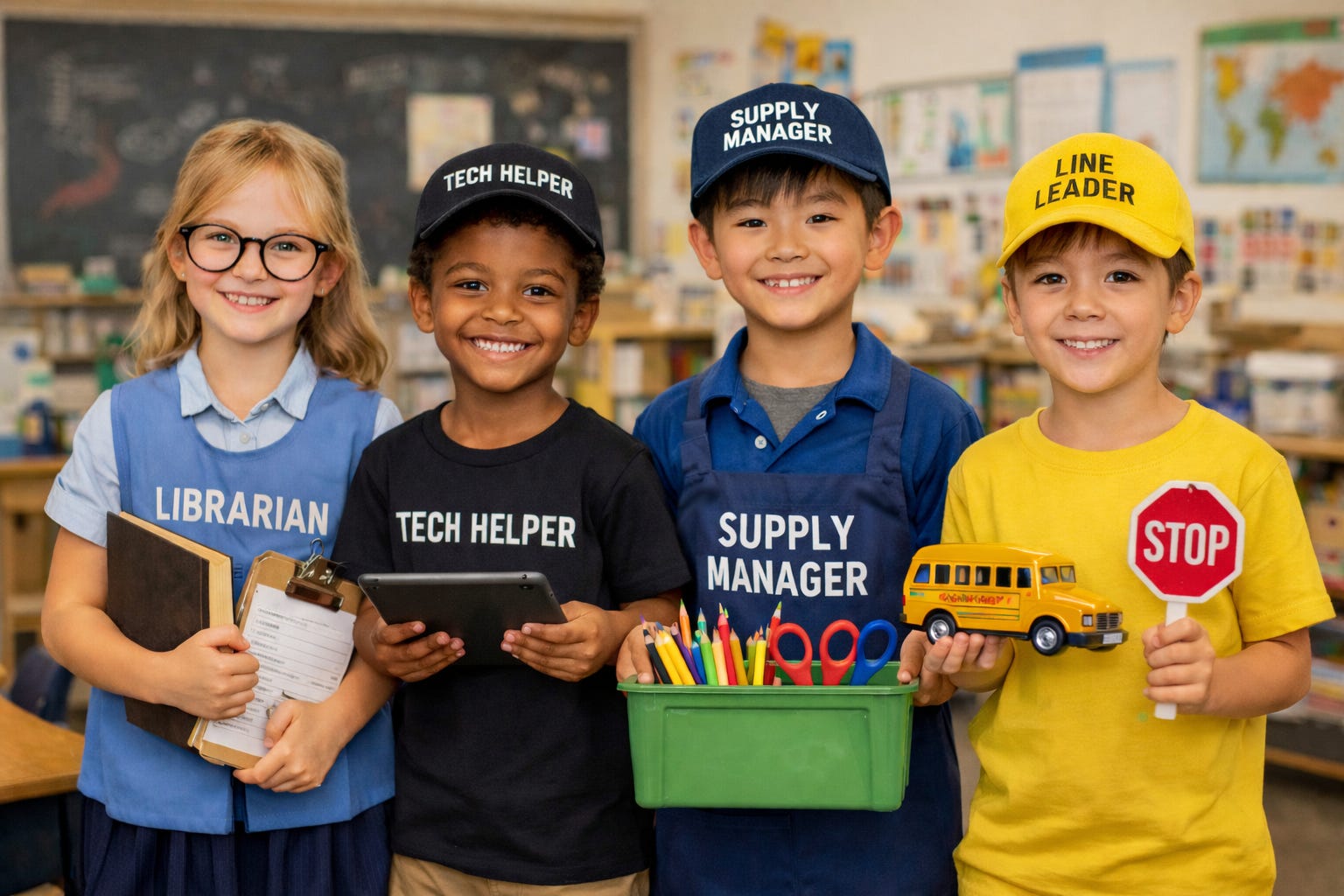
Over the past year, I have been experimenting with one such rhythm: the classroom job system.
What began as a practical attempt to organize shared responsibilities gradually became something much deeper. By redesigning how classroom jobs worked, I found myself turning the classroom into a kind of miniature society—a shared space where children were not simply following instructions, but learning how to notice needs, take initiative, negotiate with others, and carry responsibility as members of a community.
From Carpenter to Gardener
In The Gardener and the Carpenter, Alison Gopnik offers two powerful metaphors for how adults relate to children.
The carpenter wants to shape. This model imagines the child as something to be carefully molded into a predetermined ideal. The adult measures, cuts, and assembles with intention, hoping the final product will come out just right.
The gardener, by contrast, does not try to manufacture a child into a fixed form. A gardener prepares conditions. She tends the soil, protects the space, and trusts growth to unfold according to the nature of each living thing.
Traditional classroom job systems often carry a distinctly carpenter-like spirit. The teacher designs every role in advance, assigns every student a place, and tries to make the whole system look balanced and orderly from above.
What I wanted to try was different.
I wanted to move away from control and toward cultivation. I wanted to think less about how to place each child neatly into a structure, and more about how to design the conditions in which responsibility might grow on its own.
1. Letting Go of Artificial Fairness
In many classrooms, job systems are built around the idea that everyone must have a role at all times. On the surface, this feels fair. But in practice, it often leads teachers to invent jobs that do not really need to exist. Once that happens, the work itself loses weight. Responsibility becomes symbolic rather than real.
So I decided to let go of that version of fairness.
In my classroom, a job exists only if it answers a genuine need. If there is no real work to be done, there is no reason to create a position just so every child can say they have one.
At first glance, this may seem less equitable. Not every child will hold a job at the same moment. But the longer I sat with this, the more I realized: this is actually closer to real life.
A healthy ecosystem does not distribute identical roles to every living thing. A real community is shaped by need, timing, readiness, and initiative. And when some children found themselves without a job, something interesting happened. Instead of simply waiting to be assigned one, many began to pay closer attention. They watched. They noticed what was missing. They started offering themselves.
What emerged was not exclusion, but motivation.
That small sense of urgency became productive. Children began shifting from passive recipients of responsibility to active seekers of it. They were no longer asking, “What has the teacher given me?” but “What does this space need, and how might I step into it?”
To me, that is where agency begins.
2. Creating a Decentralized System
The next shift was to make the system less teacher-centered.
In many classrooms, the teacher remains the gatekeeper of every transition: assigning jobs, reassigning them, deciding when someone is done, and choosing the next person. That keeps the structure orderly, but it also keeps students dependent.
I wanted to see what would happen if I stepped out of the center.
So I introduced a more self-directed system of job transition. If a student wanted to leave a role, they needed to find someone to take their place. If a student did not yet have a role, they were encouraged to advocate for one—by volunteering, expressing interest, or negotiating with a peer.
This changed the emotional texture of the classroom in subtle but important ways.
Now, students had to learn how to hand over responsibility, not just abandon it. They had to learn how to speak up for themselves without entitlement. They had to persuade, collaborate, and sometimes deal with disappointment. Small conflicts arose, of course—but so did small acts of maturity.
And my role changed too.
I was no longer the distributor of power. I became more like the keeper of the ecosystem: watching the flow, maintaining the conditions, stepping in when needed, but resisting the urge to manage every exchange myself.
That act of restraint was not always easy. But it created space for students to do the real work of growing.
3. Making Room for New Roles
Perhaps the most meaningful part of this experiment has been inviting students to invent new jobs.
If a child notices that something in the classroom is being overlooked, and if they can make a case for why it matters and how it could work, they are allowed to create a role for themselves.
This may sound like a small detail, but to me it changes everything.
A carpenter works from a closed blueprint. Every piece already has a place. But a garden is open to surprise. New growth appears. Unexpected forms emerge. The system evolves because living things respond to the environment in ways we could not have fully predicted.
When children are allowed to create roles, they begin to see themselves not just as participants in a system, but as contributors to it. They begin asking a different kind of question—not “What is my assigned task?” but “What could I help make better here?”
That question carries the seed of citizenship.
It asks children to notice, to care, and to imagine themselves as capable of shaping the common good.
What I Have Learned
I have seen this system come alive in both first grade and kindergarten, and what has struck me most is not just how capable children are, but how often adults underestimate them.
When teachers loosen their grip—not by withdrawing support, but by offering trust alongside guidance—even very young children can do remarkable things. They can manage transitions. They can share responsibility. They can solve problems together. They can help a classroom run not perfectly, but meaningfully.
And perhaps that is the deeper lesson for us as educators.
So much of teaching is framed as intervention: how to guide, correct, shape, and improve. But sometimes the most powerful move is not to step in more, but to step back with intention. To create the soil, tend the environment, and let children practice becoming responsible members of a shared world.
Maybe that is what education is, at its heart: a gradual dismantling of adult control in order to make room for a child’s emerging self.
When we stop trying to be master carpenters, children are finally free to grow.
Reader conversation
Join the conversation
Share what this essay brought up for you—your experiences, questions, or a different perspective.