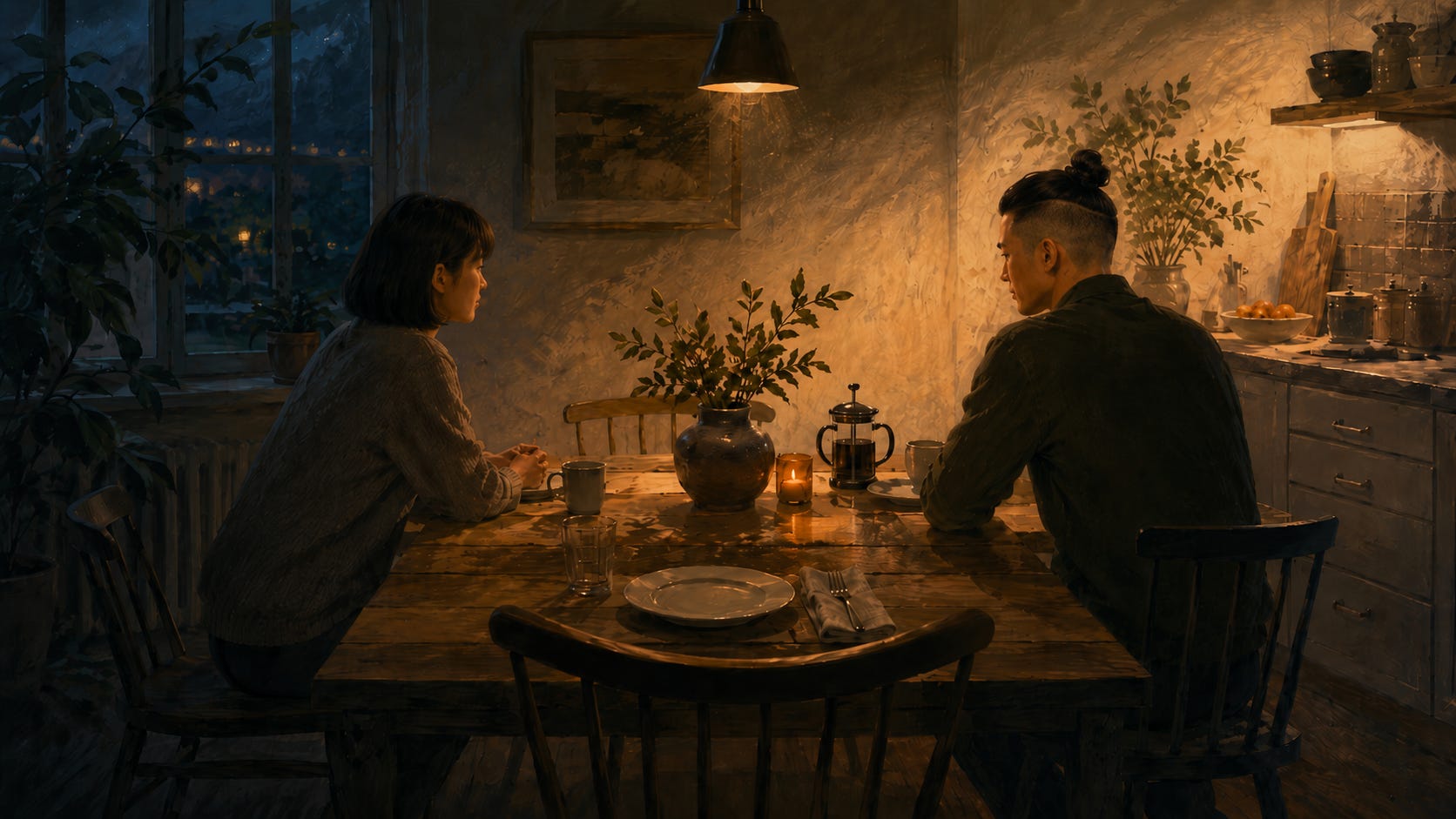
For a long time, whenever that name landed on our dinner table, the air between my husband and me would begin to harden.
She was the roommate we had once lived with for a year.
To me, the frictions of that year were no more than a seasonal allergy of shared living: sneezing, watery eyes, irritation, restlessness. Once you move away from the allergen, the body heals on its own. With a little distance, everyone can still be friends.
But for him, it had not been an allergy.
It had been a long, low-grade fever. Nothing visibly wrong on the outside, but inside, something was being quietly consumed.
And depletion rarely begins with some dramatic rupture.
It begins with things like this: she would pet the dog, forget to wash her hands, and then turn around to play with our daughter, who was only a few months old. She truly loved the baby. She simply did not think it was necessary to be that careful, and she often forgot. My husband reminded her several times. She would eventually go and wash her hands, but before the sound of running water came, she always had to win a little something back with words: an impatient mutter, a casual retort. Nothing cruel. Nothing unforgivable. And yet each time, it was like fingernails dragging across glass, leaving a sharp, invisible scratch on nerves already stretched thin.
After it happened a few times, he began, without saying anything, to build a wall between her and our daughter.
To me, these were perhaps just the kinds of “adjustments” one has to swallow when sharing a home. But for him, it was an entirely different living condition.
That year, I had just given birth to our first child. During maternity leave, almost all of my energy was trapped inside breastfeeding and the slow reconstruction of my body. I depended on him for nearly every part of daily life. When my leave ended and I returned to work, I was not actually home for much of the day. He, by contrast, became the one who stayed with our daughter around the clock.
By then, we were already deep in the pandemic. The fear, isolation, and severing of ordinary social life that had begun while I was pregnant now tightened around him and our infant daughter, pinning them inside one small space. The apartment was no longer merely a place to come back to after work. It had become the entire scene of his life, with no exit.
And so those little jabs, those reflexive comebacks, were no longer just the rough edges of someone’s communication style. They settled into something darker: his boundaries were not being respected; his discomfort was being lightly dismissed; and inside his own home, he still had to keep swallowing the sentence, “I really can’t take this anymore.”
But at the time, I did not truly see that layer.
I saw another truth.
This roommate was one of my dearest friends of many years. She had the rough, forthright manner so often associated with women from Northeast China, but underneath it she was unusually sensitive and anxious. She used rapid-fire jokes and mutual teasing to cover her unease, and that collided head-on with the gentleness and restraint rooted in my husband’s Taiwanese upbringing. Faced with that collision, he chose his habitual path: yielding. The cost was that the chronic ulcer inside him deepened.
And yet this cactus of a person, all spikes to my husband, showed me a softness and loyalty that were unmistakable.
When I developed mastitis while breastfeeding and had to go to the emergency room in the middle of the night, my husband needed to stay home with our daughter. The first person my mind reached for was her. She did not hesitate for even half a second. She said one word — “Go” — and immediately drove me to the hospital.
Another time, we had plans to go somewhere together and she canceled at the last minute. When I seriously told her I was upset, she apologized right away and never repeated it. Later, she told me that anxiety had given her a habitual instinct to avoid.
I knew her anxiety. I had also seen her sincerity.
Because I understood her, I could not help defending her a little more, making a little more room for her. I could not flatten her into “someone my husband hates.” In the coordinates of my own life, she remained a complicated but precious presence.
And so, whenever her name appeared at the dinner table, the conversation would almost immediately jam.
I thought he was making too much of it, clinging to the past.
He felt that I was ignoring his pain, standing on some moral high ground and belittling what he had felt.
After a few sentences, the argument would end, and the house would be darkened for days by cold war.
For a while, I found this kind of communication almost hopeless.
Because neither of us could change the other.
He could not simply shake that year out of his body, the way one shakes dust from a coat.
And I could not turn a friend I had truly cherished and truly understood into a mere passerby in my life.
We were like two people each gripping our own ironclad evidence, trapped in the same room while living in parallel universes.
Until one day, when that familiar gloom once again settled over the kitchen, I looked at his tense back and suddenly swallowed the sentence already rising to my lips:
“It’s been so long…”
I knew that line too well. It sounded reasonable on the surface — mature, generous, impossible to argue with.
But in that instant, I suddenly saw it for what it was: a dull knife.
It did not loudly deny his pain. It did not shout him down. But quietly, it passed judgment: your feelings have expired. Your wound does not fit my timeline for healing, and so it no longer deserves to bleed.
So I stopped.
For the first time, I tried to move my mind sideways into his world.
For the first time, I tried to move my soul into the housing of his body.
For the first time, I truly admitted that the frictions I had considered harmless had fallen on someone sensitive, someone who cared deeply about boundaries — and, more than that, on a man who, during that particular pandemic season, was parenting full-time and confined at home for months on end. For him, they had been real depletion.
Not because he was too sensitive.
But because that had, in fact, been his whole life.
That day, I walked over to him. I did not keep persuading him. I did not explain on anyone’s behalf.
I only said:
“Let’s not bring her up anymore.”
He was visibly stunned.
It was not a Hollywood reconciliation. He did not turn around and embrace me. He did not look at me with red eyes and say, “You finally understand.” He simply seemed to exhale a stale breath he had been holding for years, then lowered his head and continued wiping the stovetop.
But that slight loosening in his body made my heart ache.
It turned out that what he had been waiting for all along was not for me to share his enemy.
He had only been waiting for me to agree: let what has passed truly pass.
And in that same second, I understood that perhaps what I needed to let go of was not the friend herself.
It was the fantasy inside me that said, “If everyone could just be a little more mature, one day we could all be close again.”
When I said those words, my heart was not full of tenderness alone. There was grief in it too.
Because I knew very clearly that from that moment on, I was admitting something: this friend could never again be placed naturally back inside our life the way she once had been. Those easy, beautiful days before we became roommates were truly gone.
I could no longer pretend that if enough time passed, if everyone were generous enough, we might all sit again at the same table as if nothing had happened.
And at the same time, I felt a lightness I was almost ashamed to admit.
As if I had finally been allowed to set down the assignment of making everyone okay with one another again.
All these years, I realized, I had been quietly straining to glue a broken relationship back into its original shape. As though if I were understanding enough, diplomatic enough, patient enough, the relationship could return to what it had been.
Only that day did I see: perhaps some cracks do not need to be repaired.
They only need to be acknowledged.
The strange thing is that after that, the gloom in our home slowly began to lift.
To this day, we have not reached what anyone would call “agreement” on the matter.
I still have a close working relationship with that friend. Sometimes, outside of work, we still get coffee and chat. She remains a complicated and precious piece of the landscape of my life.
And my husband has still decided that, for the rest of his life, he wants nothing more to do with her.
These two facts stand side by side. Neither cancels out the other.
I used to think intimacy meant that two people would gradually come to occupy the same position: loving the same people, hating the same things, issuing the same verdict on the same piece of the past. As if only then could we prove we were on the same side.
So when I felt, “This really isn’t such a big deal,” I wanted him to feel the same way. I wanted him to set it down as lightly as I did.
But looking back now, I can see that this was not entirely love.
There was also a little control hidden inside it.
I was like a judge holding a ruler, weighing the frictions of ordinary life in my mind: Was this really bad enough? Was that sentence worth resenting? Did a few barbed jokes really justify a grievance that lasted for years?
I thought I was helping him gain perspective.
But to him, every piece of reasoning I offered was another attempt to cover his feelings with my facts.
The subtext of my words was really this:
“Your pain does not fit my logic, so it should not exist.”
But feelings are not math problems.
They do not need to pass through my logic before they are allowed to be real.
Only later did I slowly understand that true communication is not standing before someone’s wound and arguing over whether it should still hurt.
It is bending down first and saying: it did hurt. And yes, it left a scar.
When I finally stopped trying to prove that “it wasn’t that serious,” his defenses slowly receded.
Because what he had longed for was never for me to hand him a knife pointed outward.
What he needed was for me to see that he had truly suffered through that year.
And what I needed was not for him to go against his heart and admit that my friend “wasn’t actually that bad.”
What I needed was for him to allow me, after I had understood his pain, to still keep my friendship outside the door.
We did not persuade each other.
But we finally stopped treating difference as a failure of the relationship.
This experience reshaped my understanding of marriage.
Intimacy is not two people merging seamlessly into one body. Nor is it forcing every frequency of love and hatred into perfect resonance.
Sometimes intimacy is this:
I no longer demand that you forgive on my behalf.
You no longer demand that I be angry on yours.
I acknowledge that your pain is real.
You understand that my affection is not betrayal.
Each of us guards our own core. But at the boundary between us, we are willing to pull out a chair for the other person’s difference.
That chair may not be comfortable.
But it remains there.
I think much of the suffocation in marriage may not come from difference itself, but from how urgently we try to erase it.
We are so eager to prove that the world as we see it is the only truth. We forget that the other person may not be lying either. They may simply have been standing in another draft, brushed by another wind, and left with another body temperature.
That former roommate is still, in my world, a kind and loyal friend carrying her own real struggles.
She is also still, in my husband’s world, a memory he does not wish to revisit.
Both conclusions can be completely true at the same time.
And our marriage does not have to become fragile simply because we cannot derive one single answer.
Some relationships do not need to be restored to their original form in order to have an ending.
Sometimes the ending is simply this: I finally admit that it has changed.
That name has not vanished from our lives entirely.
It has simply lost the power to harden the air between us.
Reader conversation
Join the conversation
Share what this essay brought up for you—your experiences, questions, or a different perspective.