At the end of May this year, my husband and I took our five-year-old daughter and three-year-old son to Asia to visit family.
During the four weeks we spent in Taiwan, I began to notice something interesting.
Whenever we ran into elderly neighbors, relatives, or family friends, they would enthusiastically compliment my daughter.
“What a pretty little girl!”
Sometimes they were more specific: “Such big eyes.” “What a sweet smile.” “You look so pretty with your hair tied up.”
Even her own grandparents often couldn’t resist saying, “Look how pretty she is with her hair in braids!”
Of course, these comments all came from a place of affection. My daughter enjoyed them too. Whenever someone told her she was pretty, a shy, pleased smile would spread across her face.
But after hearing it again and again, I began to realize that almost every compliment she received seemed to come down to the same word:
Pretty.
It seemed that when people saw a little girl, this was the most natural, safest, and most immediate thing to say.
One day, I decided to talk to my daughter about it.
“What Do People Praise You for in America?”
“Sweetheart,” I asked her, “have you noticed that everyone in Taiwan likes to tell you how pretty you are?”
She nodded.
“But in America, people don’t seem to say that nearly as often. Does that mean you’re not pretty in America?”
The question stopped her in her tracks.
She stared at me, as though it had never occurred to her that prettiness might somehow change from one place to another.
“So what do your teachers and other grown-ups praise you for in America?” I continued.
She scratched her head and thought for a while before answering in her little voice:
“Being kind, responsible, and sharing.”
Being kind. Being responsible. Being willing to share.
Then I asked the question I cared about most.
“Which do you think is more important: being kind and sharing, or being pretty?”
She looked to the left, then to the right, murmuring, “Um… um…” as if she were carefully weighing two things she was reluctant to give up.
Finally, after a long pause, she said:
“Being kind and sharing is more important.”
I tried to act as though it were no big deal. Inside, I felt as if a heavy stone had suddenly been lifted from my chest.
It felt almost like an exam I had secretly been preparing for all along—and she had somehow given the right answer for both of us.
Only later did I understand why her answer had mattered so much to me.
I wasn’t afraid that she liked pretty dresses, enjoyed twirling in front of the mirror, or felt happy when someone said she looked nice.
What I was truly afraid of was that one day, she might quietly begin to equate her appearance with her worth.
I worried that after being told again and again that she was pretty, she would come to believe that this was the most important thing about her. I worried that if, one day, those same admiring looks stopped coming, she might begin to wonder whether she was still worthy of being liked.
But just as I was privately breathing a sigh of relief, my daughter turned the question back on me.
“Mommy, then why does everyone in Taiwan like to tell me I’m pretty? Don’t they think being kind is more important?”
This time, I was the one who didn’t know how to answer.
Several explanations flashed through my mind at once.
One had to do with the way older generations express affection. Another had to do with society’s heightened attention to girls’ appearances. Yet another led to gender expectations passed down from one generation to the next.
But all of that was too complicated. I didn’t know how to explain to a five-year-old why adults could say that inner qualities mattered while still commenting on a girl’s appearance before anything else.
After a moment of silence, I said:
“Maybe people here are more used to showing affection by calling someone pretty. But a person has many, many parts, and being pretty is only one small part of who you are. The way you treat your friends, what you do when something is difficult, whether you help other people—those are all parts of you too.”
She nodded, not quite understanding.
And I knew that one conversation could never shield her from all the voices around her.
She would still enjoy being called pretty. Young children enjoy almost any affirmation offered with love. And precisely because they enjoy it, the words they hear most often can slowly sink into the way they understand themselves.
“I Don’t Care Whether It’s Pretty”
Later, the question of “pretty” came up several more times.
One day at the dinner table, her A-Ma, as grandmothers are often called in Taiwan, reminded my daughter to sit properly. She told her not to put her feet on the chair and to keep her legs together.
“Why?” my daughter asked.
“Because when a girl sits like that, people can see the shorts under her skirt,” A-Ma said. “It doesn’t look pretty.”
That explanation clearly failed to persuade her.
She puffed out her cheeks and pursed her lips. She didn’t argue any further, but her silence made her displeasure unmistakable.
At lunch the next day, when A-Ma wasn’t around, my daughter finally came over to me and said:
“Mommy, I really don’t like it when A-Ma keeps saying it’s not pretty if my shorts show. I don’t care whether it’s pretty!”
She sounded both hurt and furious.
That was when I slowly began to understand that she wasn’t objecting to every rule about table manners.
She was objecting to the fact that every expectation concerning her body somehow ended up being framed in terms of whether she looked pretty.
“I understand,” I told her. “The shorts under your skirt are there to give you privacy. When you’re climbing at the playground, sitting cross-legged on the grass, or running around, it’s normal for them to show sometimes. It doesn’t mean you look bad, and it doesn’t mean you’ve done anything wrong.”
Her expression softened a little.
“But Mommy also reminds you to sit properly when you eat, right?” I continued. “Do you think I say that because it isn’t pretty when your shorts show?”
She thought for a moment.
“No,” she said quietly. “It’s because if I put my feet on the chair, I might spill my food.”
“Exactly,” I said. “Sitting securely at the table is about safety, cleanliness, and being considerate of the people around you. It has nothing to do with whether you look pretty.”
She nodded.
I later realized that A-Ma probably wasn’t simply trying to teach her how to “look pretty.”
Her words carried an entire set of rules she herself had likely been taught as a child: sit properly at the table, protect your privacy, keep your legs together, and don’t let anyone see the clothing underneath your skirt.
But in A-Ma’s language, all those complicated ideas about manners, privacy, and gender collapsed into one simple sentence:
“Girls don’t look pretty when they do that.”
She may not have realized how those words would land on a five-year-old girl.
Perhaps A-Ma meant to communicate care and good manners. What my daughter heard instead was this: The way I hold my body is being judged through someone else’s eyes.
I don’t believe A-Ma meant any harm. Quite the opposite—she was caring for and guiding her granddaughter in the way she knew best.
But perhaps this is exactly how so many rules about girls’ bodies are passed down.
They do not always arrive as harsh commands. More often, they are hidden inside concern, reminders, and good intentions, landing softly on a girl in the form of a single phrase:
“That isn’t pretty.”
The person who says it may forget the moment almost immediately.
The girl who hears it may slowly learn to look at herself from the outside.
What Else Do We See Besides “Pretty”?
After we returned to the United States, I told a friend about what had happened.
She asked me a question:
“Are you against people telling children they’re pretty?”
I thought about it and realized the answer was no.
I am not against telling a child she is pretty.
Who doesn’t enjoy a sincere compliment? When my daughter puts on a dress she loves, carefully chooses a hair clip, and runs over to show me her freshly braided hair, I think she looks adorable too.
There is nothing wrong with beauty. There is nothing wrong with enjoying it.
What unsettles me is when “pretty” becomes the first, most frequent, or even only thing people can think to say when they see a girl.
Children learn what matters by listening to the language adults use.
When a girl constantly hears praise for her eyes, hair, skin, and clothes, but rarely hears anyone notice how she comforts a friend, persists through something difficult, or asserts her boundaries, she may gradually arrive at a conclusion:
Being pretty is the most important thing about me—the thing most worth noticing.
That way of valuing girls affects them differently.
For girls who fit conventional beauty standards, appearance can become an almost effortless route to approval. They may become increasingly dependent on other people’s attention, devoting more and more energy to remaining liked and admired without ever having the chance to fully discover the wider range of their abilities.
For girls who do not fit those standards, the damage may begin even earlier.
Before they have had the chance to discover their humor, judgment, creativity, or resilience, they may already have learned to doubt themselves through adults’ comparisons, silences, or half-spoken remarks.
Of course, being called pretty does not inevitably cause a girl to disregard character or effort. A person can be beautiful and also brave, kind, and capable.
The problem is not whether those qualities can coexist.
The problem is whether our language has quietly ranked them.
When “pretty” is the word a girl hears most often, it is difficult for her not to wonder whether her looks are her greatest asset.
What I want my daughter to understand is that “pretty” is never a universal or objective verdict.
Some people like long hair; others like short hair. Some admire delicate, soft features; others are drawn to strength and sharp angles. Standards of beauty shift across cultures, eras, and places.
What we call pretty is simply a judgment made through one particular gaze, according to one particular set of standards.
It can feel good to hear.
But it should never become the final verdict on a person’s worth.
I Don’t Want Her to Be Afraid of Being Pretty
These days, I pay more attention to the way I compliment my daughter.
Sometimes, when she runs over to show me her braids, my first instinct is still to say:
“You look so pretty.”
I have no intention of banning those words. Nor do I want to turn every compliment she receives into a tense lecture about what gives girls value.
If enjoying beauty itself becomes something we must constantly guard against, then we have only replaced one set of rules with another.
I simply don’t want “You’re so pretty” to be the sentence she hears most.
So I try to keep looking.
I notice when she gives the last snack to her little brother.
I notice when she clearly tells A-Ma that she doesn’t like what was said.
I notice when she is afraid but tries anyway.
I notice when she cries after failing, then gets back up and begins again.
I also try to rely less on broad labels.
Instead of simply saying, “You’re so smart,” or “You’re such a good girl,” I tell her:
“Your brother was upset just now, and you sat beside him. I could see how much you cared about him.”
“That was really difficult, but you kept trying and didn’t give up.”
“You said something when you felt uncomfortable. That’s important.”
These words are not somehow nobler than “You look pretty.”
They simply help her see that she is not a little girl who exists only to be looked at.
She is someone who chooses, acts, creates, and shapes the world around her.
I don’t want my daughter to reject the word “pretty.”
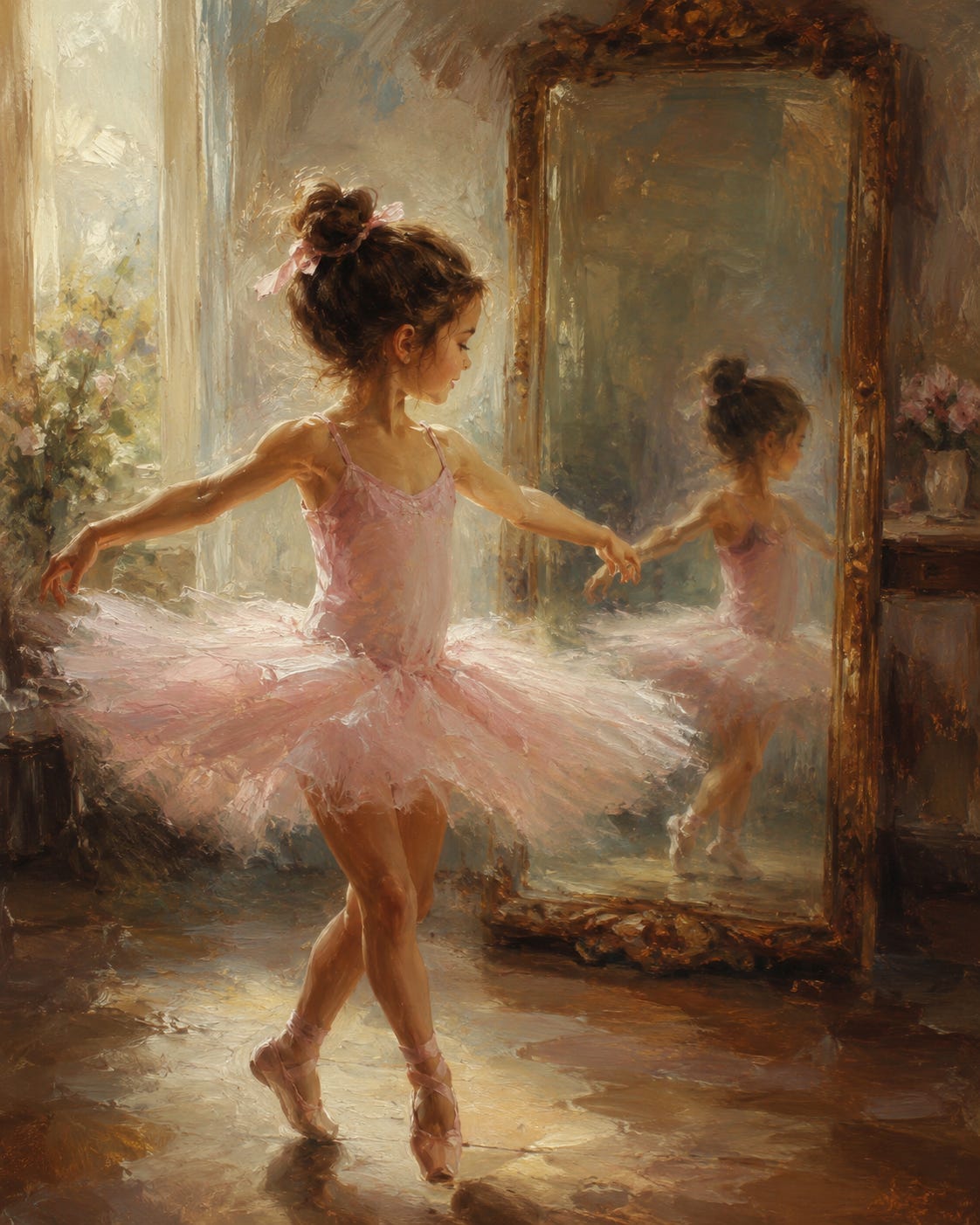
She can love dresses and hair clips. She can twirl in front of the mirror after having her hair braided. And when someone tells her she looks beautiful, she can happily say thank you.
I only hope she will gradually come to understand that being pretty is one way other people may see her.
It is not the only way she can know herself.
Beauty is only one small part of a much larger self.
The way she treats other people. The way she protects herself. The way she responds to failure. The way she keeps moving forward even when she is afraid.
All of these things make her who she is too.
I hope that one day, even if no one ever praises her appearance, she will still know exactly who she is.
Reader conversation
Join the conversation
Share what this essay brought up for you—your experiences, questions, or a different perspective.