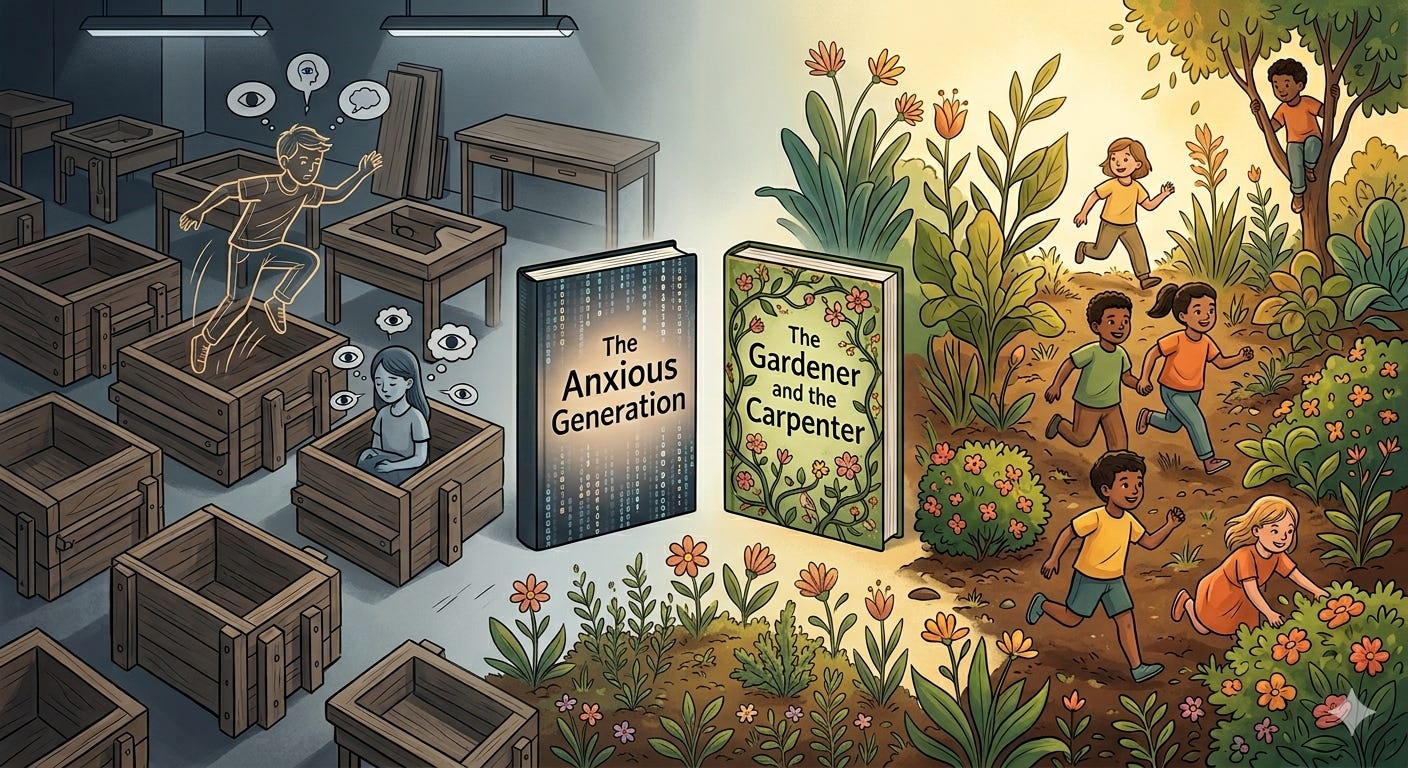
At the beginning of this school year, something in me shifted.
Not all at once. Not dramatically. Just quietly, in the middle of ordinary school days.
I started noticing that my old understanding of “classroom discipline” no longer fit what I was seeing in front of me.
As a teacher, I spend a lot of time with young boys who seem to have an almost elemental force inside them. They move constantly. They bump into each other. They chase, wrestle, laugh, argue, and sometimes seem physically unable to contain themselves within the invisible boundaries of a classroom.
For years, I understood this the way many educators are trained to understand it: as a behavior problem. The child who sits still, listens quietly, and follows directions is seen as ready to learn. The child who fidgets, blurts, pushes, or turns every transition into motion is seen as resisting learning.
But lately, I’ve started asking myself a different question:
What if some of what we call misbehavior is not defiance at all? What if it is a child’s developmental nature colliding with a school structure that was never really built for them?
That question stayed with me as I read Jonathan Haidt’s The Anxious Generation and Alison Gopnik’s The Gardener and the Carpenter. Together, those books gave language to something I had been feeling but had not yet fully named.
They helped me see that what looks like disorder is not always dysfunction. Sometimes it is life itself, asking for the right conditions.
Children Are Not Furniture
One of the ideas I keep returning to is Alison Gopnik’s metaphor of the carpenter and the gardener.
A carpenter works from a blueprint. There is a plan, a desired outcome, and a clear image of what the finished product should look like. The work is about shaping, refining, correcting, and controlling.
A gardener works differently. A gardener does not force a rosebush to become a tree. A gardener does not stand over a seedling and demand that it grow faster, straighter, or more symmetrically. A gardener pays attention to the soil, the light, the water, the climate. A gardener creates conditions in which growth becomes possible.
The more I reflect on schools, the more I realize how often we still act like carpenters.
We ask children to sit for long stretches. We ask them to be quiet, self-controlled, verbally responsive, and physically contained. We call those traits “readiness.” We reward children who can adapt to those expectations early, and we worry about the ones who cannot.
But children are not furniture. They are not projects to be assembled.
And when schools function like workshops instead of ecosystems, some children inevitably look more successful than others—not because they are healthier or more whole, but because they fit the mold more easily.
Boys and the Kind of Energy School Often Punishes
This is where I think about boys.
Of course, not all boys are the same, and not all girls are the same. But in broad strokes, many boys seem to need something school is increasingly unwilling to give them: movement, physical play, roughness, risk, and space.
In The Anxious Generation, Haidt writes about the shift from a play-based childhood to a phone-based childhood. That line has stayed with me, because it explains so much.
Many boys learn through action. Through motion. Through physical experimentation. Through rough-and-tumble play, they test limits, negotiate rules, repair conflict, and build social understanding. They do not always process the world best through stillness first. Sometimes they need to move in order to arrive at calm.
When I watch boys pushing, chasing, or colliding and then laughing together again a minute later, I no longer want to rush in and interpret the whole thing through the language of correction.
I find myself wondering: what are they practicing here? What are they learning from one another? What part of development is happening in this messy, noisy, physical exchange that cannot happen in a worksheet or a lecture?
We live in a world where children are increasingly overprotected in real life and underprotected online. In that kind of world, I suspect these physical, embodied interactions may be some of the last places where boys are still practicing risk, resilience, and repair.
And when adults respond only by cutting off every rough edge, I worry that we are not just preserving order. We may also be cutting away part of the natural ground in which boys grow socially and emotionally.
Girls and the Quiet Burden of Being Good
Girls, of course, are carrying a different burden.
Many girls enter school already more fluent in the language of relationship. They are often more attuned to tone, emotion, expectation, and approval. In a traditional classroom, those traits are frequently rewarded. Girls are often seen as “doing well” because they can sit, comply, respond, and self-monitor in ways that fit school more naturally.
But that does not mean they are untouched by harm. Often it means the harm is easier to miss.
In the digital age, the very qualities that once helped girls connect can become liabilities. Social awareness becomes self-consciousness. Relational sensitivity becomes anxiety. Friendship becomes performance. What was once private becomes public, visible, measurable, and judged.
A girl may look successful on the outside while carrying an exhausting inner pressure to get everything right, to be liked, to be approved of, to be good in every visible way.
And I think that matters deeply.
Because if boys are often corrected for externalizing their needs, girls are often praised for internalizing theirs.
That is not health. That is not freedom. That is not the same as flourishing.
What Fairness Means to Me Now
This is why I have started thinking differently about fairness.
For a long time, fairness in school has been confused with sameness. Same expectations. Same structure. Same pace. Same rules. Same idea of what a “good student” looks like.
But real fairness is not sameness.
Real fairness means recognizing that different children need different conditions in order to thrive. It means understanding that equality is not giving every child the same pot—it is giving each child the kind of soil, light, and care they actually need.
In my own classroom, I’ve started trying to make small shifts.
I want to make more room for movement, more room for hands-on learning, more room for children to use their bodies as part of how they think. I want to pause before labeling every burst of physical energy as a problem. I want to distinguish more carefully between what is truly harmful and what is simply lively, immature, unfinished, and deeply human.
I also want to create spaces where girls can exist outside the constant pressure of evaluation—spaces where they are not always being measured, watched, or quietly trained to perform competence. I want them to experience joy that is not curated, confidence that is not borrowed from approval, and connection that is not shaped by an invisible audience.
I Don’t Want to Be a Carpenter Anymore
The older I get, the less interested I am in producing polished children.
I do not want to spend my teaching life trimming children into shapes that make adults more comfortable.
I do not want to confuse compliance with health.
I do not want to call every form of wildness a problem.
What I want instead is to become the kind of teacher who knows how to tend.
A teacher who can tell the difference between danger and vitality.
A teacher who knows that growth is often uneven, inconvenient, and alive.
A teacher who understands that the goal is not to manufacture children into something impressive, but to protect the conditions under which they can become fully themselves.
That, to me, is what it means to be a gardener.
And in this age of digital anxiety, I am starting to think gardeners are exactly what children need most.
Because children do not need more adults standing over them with sharper tools.
They need adults who know how to protect the soil.
References & Further Reading
Haidt, J. (2024). The Anxious Generation: How the Great Rewiring of Childhood Is Causing an Epidemic of Mental Illness. Penguin Press.
Gopnik, A. (2016). The Gardener and the Carpenter: What the New Science of Child Development Tells Us About the Relationship Between Parents and Children. Farrar, Straus and Giroux.
Reader conversation
Join the conversation
Share what this essay brought up for you—your experiences, questions, or a different perspective.