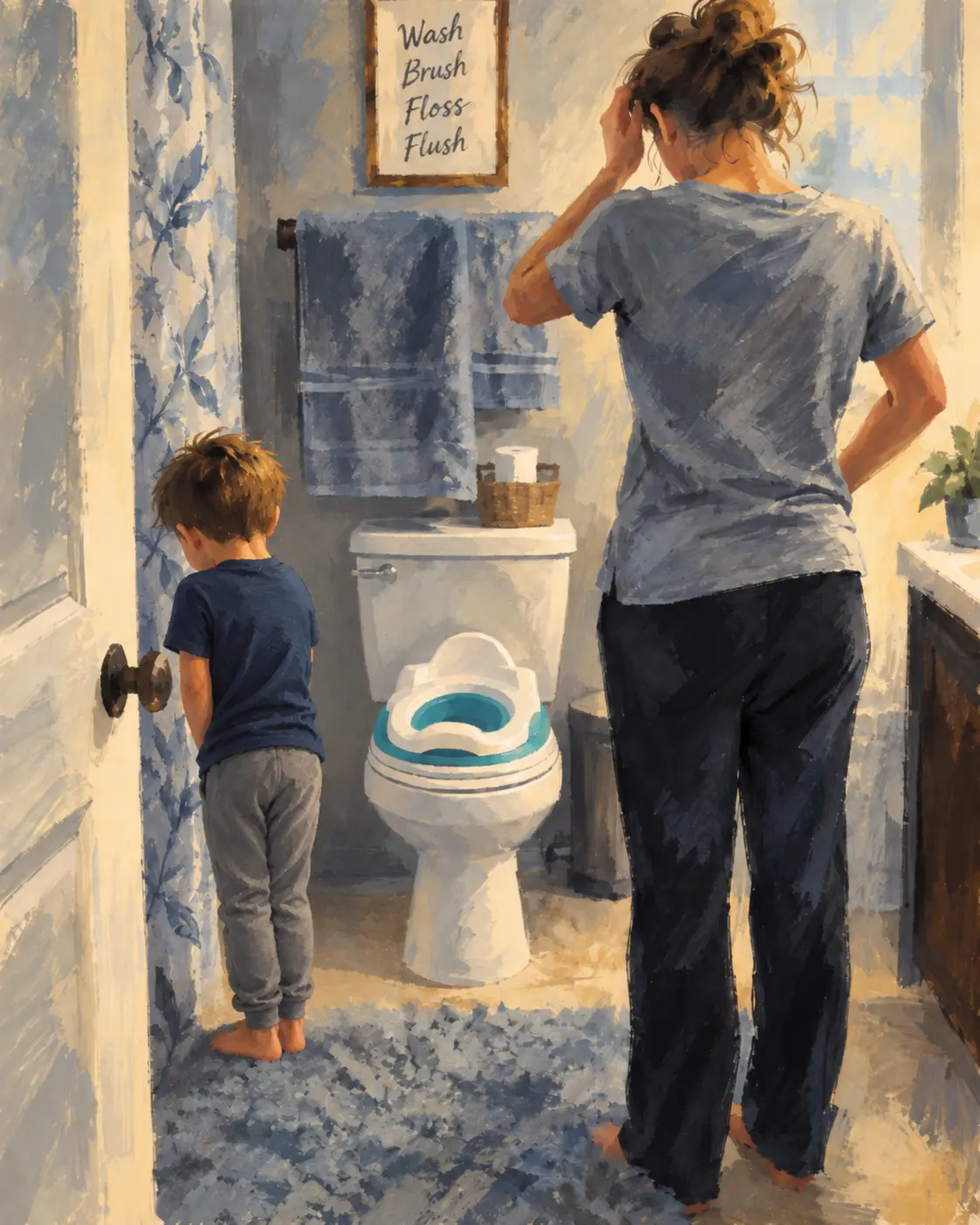
I’ve developed a habit when I pick my son up from daycare.
As soon as I walk into his classroom, I look at his cubby.
If it’s empty, I feel absurdly lucky. If there’s a heavy plastic bag hanging from it, my heart sinks.
Inside is a pair of underwear he has pooped in.
At first, I would bring it home and try to wash it. Eventually I learned that underwear covered in poop and sealed inside a plastic bag all day is nearly impossible to get truly clean. After a few tries, I gave up. Now I throw away the whole thing, bag and all.
But the underwear was never the hardest part.
My son started potty training when he was two and a half.
Pee came easily. My husband and I were thrilled. We thought it would be like it had been with his older sister—quick and straightforward. The biggest step was already behind us, we thought. The rest was probably just a matter of time.
More than six months passed.
He still refused to poop on the toilet.
Before long, we were stuck.
If we sent him to daycare in underwear, he would occasionally poop in his pants. After several accidents, the daycare asked us to put him back in diapers. But once he was wearing a diaper, he stopped wanting to pee in the toilet too. He simply did everything in the diaper.
We watched the habit he had worked so hard to build begin to disappear, and we grew increasingly anxious.
We read books. We searched online. We tried almost everything we could think of.
Rewards. Reminders. Encouragement. Sitting with him. Even deliberately pretending not to care.
Nothing seemed to make much difference.
We wanted him to learn so badly.
Expectation followed by disappointment, over and over, slowly turned into a kind of pressure that filled our home. We didn’t even realize how much of it he could see.
When our son pooped in his underwear, my husband or I would clean him up. We might not have scolded him, but our impatience was there—in our voices, on our faces, in the way our movements became a little sharper as we scrubbed the mess out of his clothes.
Of course he could feel it.
The more he needed to poop, the more emotional he became and the more fiercely he resisted the toilet. The more anxious we became, the more he resisted. The more he resisted, the more frustrated we became.
We couldn’t seem to break the cycle.
Then, just after he turned three, something suddenly changed.
There was no special reward. No new method.
One day, he simply went to the toilet at home and pooped.
Then he did it again.
And again.
We were ecstatic.
All the books we had read, all the things we had said, all the failed attempts—it felt as though they had finally done their work somewhere we couldn’t see.
We thought we had finally arrived at that moment parents are always told to wait for:
When a child is ready, it will happen naturally.
We quickly shared the good news with his daycare and started sending him in underwear again.
We knew a different environment might take some adjustment.
We didn’t realize how much.
Weeks passed, and he still refused to poop on the toilet at daycare. Every few days, when I came to pick him up, I would find that heavy plastic bag hanging from his cubby.
Eventually, it stopped being just a plastic bag.
When it wasn’t there, I felt enormous relief.
When it was, my first thought was always the same:
We failed again today.
The progress is disappearing.
My mood could drop in the instant I saw that bag.
For the rest of the evening, I would have less patience. My son walking a little too slowly, not eating his dinner, or crying over something small could be enough to set me off.
He would sense our mood and become more sensitive himself. His crying would make us even more exhausted.
One dirty pair of underwear could derail the entire evening.
Eventually my husband and I realized we couldn’t keep going like this.
So we stopped.
We stopped expecting him to poop on the toilet at daycare. We put aside, at least for a while, every goal and expectation we had attached to it.
He went back to wearing diapers at daycare and underwear at home.
There were still occasional accidents. But if we cleaned them up quickly, they somehow didn’t seem quite so unbearable.
Nothing had actually been solved.
But the air in our home loosened a little.
At the end of May that year, we took both kids to Taiwan and mainland China for six weeks.
Before we left, we prepared ourselves for the worst.
New homes. New routines. Unfamiliar bathrooms everywhere we went.
Any of it could have made things harder. We were even prepared to keep our son in diapers for the entire trip and stop expecting anything at all from potty training.
Instead, to our surprise, after a few accidents at the beginning, he spent most of the trip pooping on the toilet.
He could use the bathroom at a campground.
He could go with A-gong.
One day, my husband and I went out to run some errands. When we came back, A-gong and A-ma told us that our son had announced on his own that he needed to poop, then followed A-gong to the bathroom and sat on the toilet without any trouble.
We stared at them in disbelief.
Until then, he had needed either my husband or me with him, and he had almost always insisted on using the toilet at home.
But while traveling, he moved from one unfamiliar bathroom to another as though it were nothing.
It was as if the child who had cried and fought us over pooping had suddenly disappeared.
Once again, we were ecstatic.
Maybe this time, it really was over.
Then we came back to the United States.
Almost immediately, he went straight back to where he had started.
He would rather poop in his underwear than sit on the toilet at daycare. After two straight weeks of accidents, we put him back in diapers again.
And it wasn’t only daycare.
He started having frequent accidents at home too.
The hardest part wasn’t cleaning him up.
It was that we had already seen what he could do.
We knew he could sit on an unfamiliar toilet. We knew he could go with A-gong. We knew he could do it without us there.
And yet, back here, suddenly he couldn’t.
We didn’t know why.
We didn’t know how long it would last.
We knew all the things parents are supposed to know.
Development isn’t linear. Regression after a big transition is normal. Adult anxiety only adds more pressure.
We knew because we had read it, and because our son had already shown us. When we loosened our grip on the outcome, he sometimes found his own rhythm.
We knew all of this.
None of it helped when another pair of dirty underwear appeared in front of me.
I still felt the irritation first.
When I smelled that familiar smell and saw my husband’s face fall, I still felt disappointed. Helpless.
Sometimes what hurt most wasn’t even the problem itself.
It was the fact that we had tried so hard.
We had read the books. Done the research. Changed our approach. Reminded ourselves not to push, not to blame him, not to make him carry our anxiety.
And when we realized we were trying too hard, we tried to learn how to let go.
But doing the right thing doesn’t mean things will start happening at a pace that makes us feel better.
I have always found that hard to accept.
Maybe that’s why, one morning at five, my son’s voice pulled me so easily out of sleep.
“Blanket, blanket, blanket…”
I got out of bed, went to his room, pulled the blanket back over him, and returned to my own bed.
According to my plan, I still had another half hour to sleep before getting up to exercise.
But once I lay down, my heart wouldn’t slow.
I could feel irritation and resentment rising almost immediately.
Why couldn’t you have waited thirty more minutes?
Why can’t you pull the blanket up yourself?
Why do all these things that seem so simple have to require us, over and over again?
I started taking slow breaths. I told myself what I already knew by heart.
He’s still little.
This will pass.
Soon enough, just like his sister, he’ll learn to pull up his own blanket.
In a few years, I’ll sleep through the night without anyone waking me.
One day, I might even miss being needed this way.
All of it was true.
None of it gave me back the half hour.
Knowing that one day he would pull up his own blanket did not give me the sleep I had lost that morning.
Just as knowing that one day he would poop comfortably in any bathroom did not clean the dirty underwear in front of me today.
He will grow up.
But today is still hard.
Eating. Sleeping. Going to the bathroom.
The most ordinary things can sometimes be the ones that leave parents feeling most powerless.
We can prepare food, but we can’t make a child hungry.
We can create a bedtime routine, but we can’t fall asleep for him.
We can buy the little potty, read the parenting books, try one strategy after another.
But we cannot decide for him whether today will be the day he sits down on that toilet.
There is so much we can do.
And then, at a certain point, we reach the edge of what is ours to do.
That last little stretch belongs to the child.
We have to wait for him to cross it himself.
And somehow, that little stretch can feel like the longest one.
All we can do is wait.
I still resist the helplessness inside that sentence.
Because waiting means admitting that some things will not happen faster just because I am more diligent, more thoughtful, more patient, or trying harder.
I can read more. I can change my approach. I can work on my own impatience. I can change the conditions around him.
I still cannot make him ready.
Parenthood keeps teaching me this.
Each time, I think I understand it a little better.
And the next time, I find myself impatient all over again.
Waiting has never felt like a light, airy word to me.
Waiting is pair after pair of dirty underwear.
It is evenings when patience runs out.
It is hope rising, only to fall again.
Sometimes it is half an hour awake at five in the morning, after a child calls you from the next room and you can’t fall back asleep.
I don’t know whether I’ll still feel irritated the next time I see that plastic bag hanging from my son’s cubby.
I probably will.
I don’t know how much longer it will take before he is willing to sit on the toilet at daycare.
Maybe it will happen soon.
Maybe it will take a long time.
Outside, it is still dark.
My heartbeat has finally begun to slow.
There isn’t much time left before my alarm goes off. I don’t know if I’ll manage to fall asleep again.
But when morning comes, I’ll get up anyway.
I’ll help my son get dressed. I’ll put diapers and a clean pair of pants in his backpack. Then I’ll take his hand and walk out the door with him.
There may be another plastic bag waiting for me in his cubby this afternoon.
But first, morning.
Reader conversation
Join the conversation
Share what this essay brought up for you—your experiences, questions, or a different perspective.