We often envy the innocence of children.
Their openness. Their softness. Their ability to feel everything so fully, before the world teaches them to flinch.
But from a neuroscientific perspective, childhood is not just a season of wonder. It is also a season of vulnerability.
Because children do not yet have what adults do.
They do not yet have the deep power of conscious choice.
And that changes everything.
1. Early Life in “Sponge Mode”: The Age of Unconscious Absorption
A child’s brain exists in an extraordinarily plastic, absorbent state. In the early years of life, because the Reticular Activating System (RAS) has not yet fully matured, the brain takes in the surrounding world with very little filtering.
It absorbs almost everything.
The loving words. The careless remarks. The praise. The tension. The silence. The look on a parent’s face that says more than language ever could.
A child has no real filter for any of it.
That is the beauty of childhood—but also its cost.
Because when the mind is in “Sponge Mode,” it does not yet know how to separate what is nourishing from what is harmful. Encouragement can sink in deeply. But so can a passing criticism. So can emotional neglect. So can the subtle feeling that love must be earned.
And many of the beliefs we struggle with in adulthood—I’m not good enough. I always mess things up. I have to be more to be worthy—are often not conclusions we consciously chose.
They are residues.
Old messages, passively absorbed before we had the power to question them.
2. Adulthood in “Gatekeeper Mode”: The Loyal but Stubborn Old Butler
Then adulthood arrives, and the brain changes strategy.
The RAS steps into its full role as a filter—a gatekeeper. Its job is not to show you reality in some pure, objective form. Its job is to help you survive efficiently.
And to conserve energy, it does what all efficient systems do: it stops paying attention to most things.
In fact, it filters out the overwhelming majority of incoming information, relying on shortcuts, patterns, and psychological heuristics to decide what deserves your notice.
Which would be helpful—if it were neutral.
But often, it is not.
The adult RAS behaves like a “loyal but stubborn old butler,” faithfully carrying around old film stills from your childhood—your earliest emotional programming—and comparing them to everything you experience now.
And because it is loyal, it keeps serving the same script.
Even when that script is hurting you.
The trap of rigidity: when the brain becomes a mirror that reflects only shadows
If you leave the system on “Autopilot,” the RAS begins filtering reality through old templates. And this is where Confirmation Bias takes over.
Say the old script is: I’m not good enough.
Then watch what happens.
A compliment comes in, and the old butler frowns: That doesn’t match the film still. There must be some mistake.
A criticism appears, and suddenly he lights up: Ah. There it is. Proof. This is the real you.
So even if your life is full of evidence that you are capable, loved, resilient, growing—your perception may still stitch together a story of inadequacy.
That is the cruelty of selective blindness.
You can be standing in a field of evidence and still feel starved of proof.
You can succeed in ten ways and go to bed haunted by the one thing that felt like failure.
And the most painful part is this: it feels like truth.
But it is not truth.
It is pattern recognition distorted by history.
It is an old script replaying itself in the name of efficiency.
It is a biased mirror, not an objective one.
And the first step toward change is realizing that the mirror has been tilted all along.
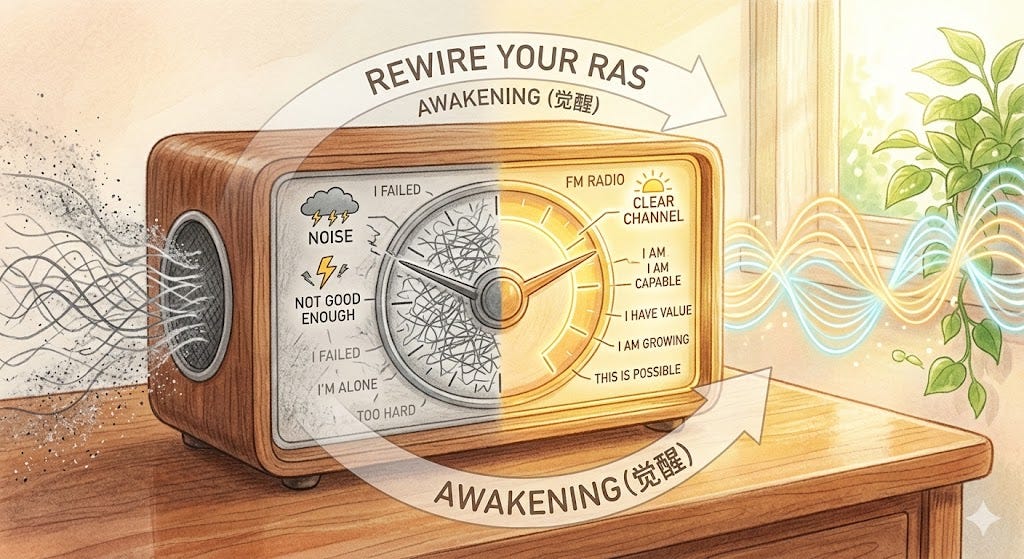
3. Rewiring: From “Autopilot” to Conscious Awakening
This is where adulthood becomes not just difficult, but sacred.
Because although adults may no longer possess the openness of childhood, they possess something far more powerful:
the ability to intervene.
To notice.
To choose.
To participate in their own mental architecture.
You are no longer just the sponge.
You are the architect of the house.
And that means you can begin to recalibrate your RAS—deliberately, patiently, consciously.
① Awareness: Catch the Filter in the Act
The first step is not forcing a new belief.
It is noticing the old filter while it is running.
When you obsess over one criticism and mentally discard nine sincere compliments, pause and tell yourself:
This does not mean I am actually terrible. It means my RAS old butler is executing old instructions.
That single moment of awareness matters more than it seems.
Because awareness creates distance.
And distance breaks fusion.
It is like turning on a spotlight in a dark theater. The moment the light comes up, the illusion loses some of its power. You begin to see the script as a script.
Not as destiny.
Not as identity.
Just as conditioning.
② Recalibration: Give the Brain New Search Keywords
Once you notice the old filter, the next step is to retrain it.
The RAS is always scanning for what it believes matters. So give it a new assignment.
Ask yourself every day:
What happened today that proves I am actually capable?
What did I handle well?
Where was I more grounded than I used to be?
What small detail did I overlook because it did not fit my old story?
These questions are not empty affirmations. They are instructions.
They are new search keywords.
And once those keywords change, your perceptual world begins to change with them.
Things that once went unnoticed start to emerge:
the way you listened patiently instead of reacting defensively.
The email you sent on time.
The boundary you held.
The task you finished even though you were tired.
The moment you chose kindness over collapse.
These may seem like small things. But they are not small to the nervous system.
They are evidence.
And evidence, gathered honestly and repeatedly, has the power to crack open an old identity.
Like green shoots pushing through dry ground, these small facts begin lighting up across what once felt like a barren inner landscape.
You are no longer trying to shout down an old belief with slogans.
You are using reality to outgrow it.
③ Consolidation: Repetition Wears Down the Old Path
This is where many people give up too early.
They think: I’ve tried to think differently, but it feels exhausting. So maybe it isn’t working.
But exhaustion does not always mean failure.
Often, it means friction.
It means the brain is being asked to stop taking the old, energy-efficient route and begin laying down a new one.
And of course it protests.
That is what brains do.
This is where Neuroplasticity matters. This is where Hebb’s Law matters: “neurons that fire together wire together.”
The thoughts you repeat are not just passing through your mind. They are helping shape its pathways.
So when the new way of seeing yourself feels awkward, effortful, unnatural, even emotionally expensive—that does not mean you are doing it wrong.
It may mean rewiring is already underway.
Through consistent Repetition, the once-scattered evidence for maybe I’m actually okay… maybe I’m more capable than I thought… maybe the old story isn’t the whole story begins to gather force.
Eventually, it becomes a current.
And over time, that current can carve a new path stronger than the old groove.
The Tender Truth
Children meet the world through absorption.
Adults define themselves through selection.
That is both the burden and the gift of growing older.
So if you feel discouraged because you cannot seem to break free from an old pattern, please let this be the part you remember:
your brain is not resisting change because you are weak.
It is resisting change because it learned, long ago, that familiarity was safer than freedom.
It is trying—however imperfectly—to protect you.
And that deserves compassion.
But protection is not the same as destiny.
You are no longer trapped in “Sponge Mode.”
You do not have to live forever in “Autopilot.”
You now possess the power of conscious choice.
And every time you consciously choose what enters your awareness—every time you interrupt the old filter, question the old script, and let new evidence in—you are doing something profoundly loving.
You are writing a different future with the attention you give the present.
A love letter to your future self, one act of conscious filtering at a time.
This time, what enters your awareness is yours to decide.
References
Vignola, N. (2024). Rewire: Break the Cycle, Alter Your Thoughts and Create Lasting Change. Penguin Life. (Primary reference for the book’s core arguments on the filtering role of the Reticular Activating System (RAS), psychological heuristics, and Neuroplasticity.)
Confirmation Bias in Perception.
Based on neuroscientific theories concerning how Confirmation Bias influences the RAS in filtering environmental information.
Neuroplasticity and Hebbian Learning.
Referring to the application of Hebb’s Law—“neurons that fire together wire together”—in adult brain rewiring.
Reader conversation
Join the conversation
Share what this essay brought up for you—your experiences, questions, or a different perspective.