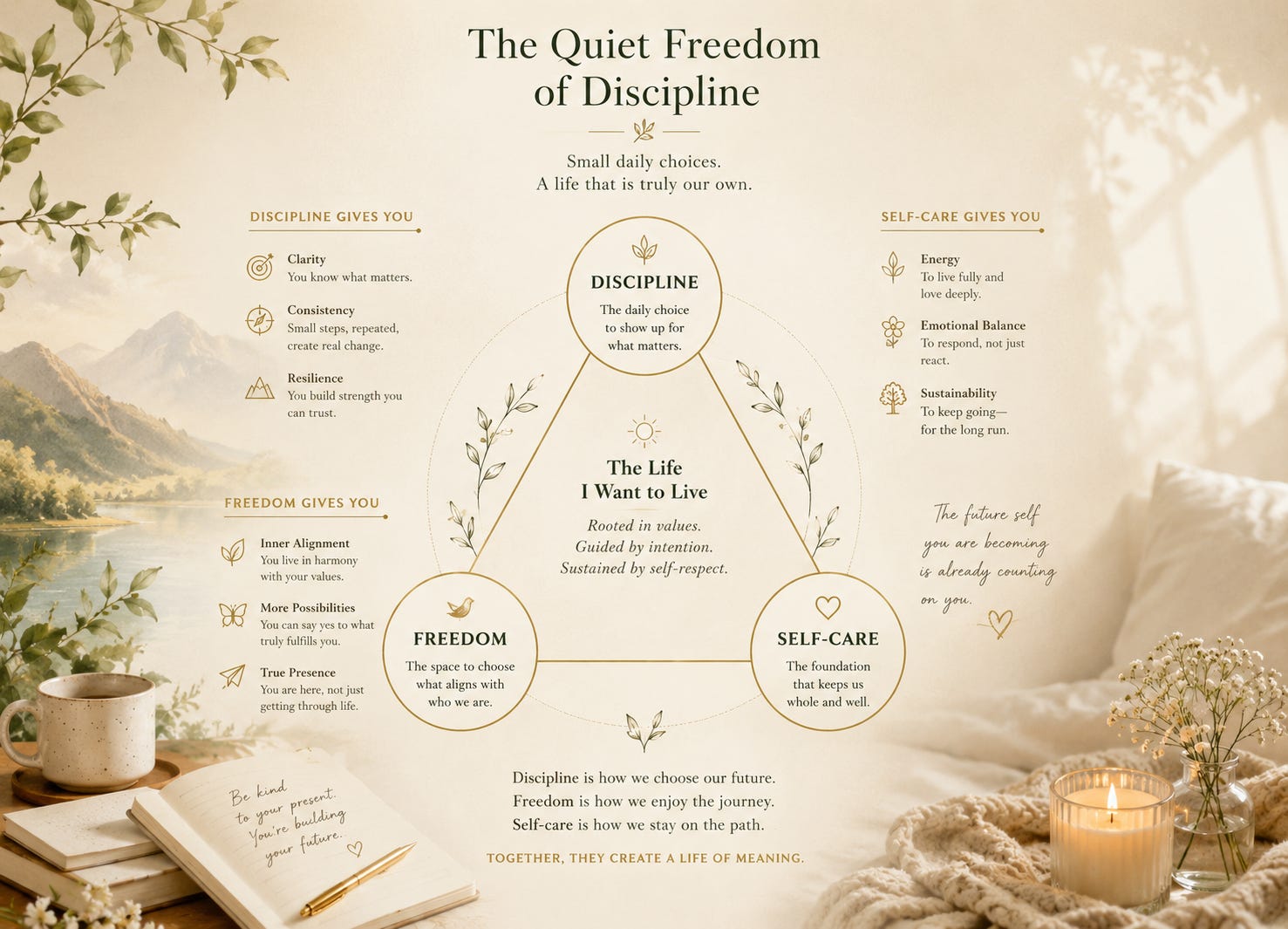
I used to talk with friends about things like eating more mindfully, exercising, going to bed earlier — all the small, unglamorous practices we tend to place under the word discipline.
Almost inevitably, someone would sigh, half joking and half serious:
“If you can’t even eat whatever you want, whenever you want — if you can’t even enjoy good food freely — then what’s the point of life?”
Every time I heard that, I felt myself pause.
Not because I didn’t understand the pleasure they were talking about. I understood it completely.
After a long day, collapsing onto the couch and disappearing into my phone feels good. Eating something rich and comforting late at night can feel like a kind of mercy. Spending an entire weekend day with no plan, no ambition, no responsibility — just lying there, letting the hours blur — has its own undeniable sweetness.
Those moments are not fake happiness.
And yet, somewhere in me, I have always felt that the story is more complicated.
If a certain kind of “freedom” leaves me more exhausted, more foggy, more out of control, and less like myself, then is it really freeing me?
Or is it quietly taking away my capacity to choose?
What I want to push back against is not pleasure itself.
It is the idea that immediate gratification is the same thing as freedom.
For many of us, discipline and freedom seem like natural enemies. To choose discipline is to place a leash on desire. To be disciplined is to sacrifice the pleasure of the present moment for some stern, future version of ourselves.
But the older I get, the less I believe they are opposites.
The thing that changed my understanding of discipline was not some triumphant moment at the gym. It was not the clean satisfaction of finishing a plan or checking off a list.
It was a very ordinary night.
Almost embarrassingly ordinary.
I had decided, around that time, to start going to bed earlier.
“Decided” makes it sound more decisive than it was. In reality, I had spent at least a week negotiating with myself. Every night, I told myself: Just a little longer tonight. I’ll start tomorrow. One more late night won’t matter.
The night I finally did it, I turned off my phone and laptop with great reluctance.
The screens went black.
The room became suddenly quiet.
Not peaceful, exactly. Just quiet in a way that felt unfamiliar.
I read for a while. Then I got up and wandered around, inventing small tasks. I poured a glass of water. I cleared my desk. I organized things that could just as easily have waited until morning. My hand kept reaching for my phone without my permission, as if some life-altering message might arrive the moment I looked away.
It was a strange feeling.
Not suffering, exactly.
More like withdrawal from a rhythm I had mistaken for rest.
My body was tired, but my nerves were still running on the old track, spinning in place. It was clearly time to sleep, and yet my mind kept searching for the next bright thing, the next tiny spark, the next excuse not to be alone with the end of the day.
Eventually, I made it to bed.
Even as I lay down, I felt a small, unreasonable resentment. As if I were not caring for myself, but surrendering some private sovereignty of the night.
The next morning, I woke up a little dazed.
But the daze was different from my usual heaviness. It was not the dullness of having been drained past my limit. It was the soft blankness of a body that had finally been allowed to rest.
And suddenly I realized how long it had been since I had loved my body in this very basic way.
With sleep.
With enough sleep.
It had been so long that I had almost forgotten the plain, quiet happiness of waking inside a body that had been cared for.
That was the moment I understood something.
Discipline is not always the heroic act of defeating desire.
Sometimes it is simply saying to yourself, after far too long:
Enough. I won’t keep borrowing from you today.
After that, I began to see many “disciplined” things differently.
Exercise, for instance.
Of course I work out for practical reasons. I want fewer illnesses. I want to be less at the mercy of work and exhaustion. I want to feel less afraid of losing control over my body as I get older.
But beneath all of that is something simpler and more stubborn:
I do not want to leave my own life too early.
I want to be fifty and still able to hike, to play, to travel, to move through the world with appetite. I want my children, when they are grown, to see me not only as the mother standing at the edge of things, reminding everyone to be careful, but as someone still capable of joining in.
Someone with strength.
Curiosity.
A body that still says yes.
I even have a very specific, slightly greedy wish.
One day, when my children have children of their own, I want to be the kind of grandmother who can run with them, jump with them, get muddy with them, play until everyone is out of breath.
I do not want to be only the woman sitting in a chair, smiling, taking photos, handing out water, saying, “You young people go ahead.”
I want to be able to follow when the children run toward the grass.
I want, when they turn around laughing and shout, “Grandma, come on!” — not merely to wave from a distance, but to actually run toward them.
Of course this is about health.
But not only health.
It is about aliveness.
It is about my refusal to let my life force quietly recede before it has to.
I do not want to imagine aging, especially female aging, as a slow narrowing. A gradual quieting. A polite stepping aside.
I want to imagine it as something that can keep expanding.
With muscle.
With wind.
With laughter.
With a heart still willing to run forward.
So no, discipline, for me, is not about earning the freedom to do nothing.
That, to me, is closer to indulgence.
What I want is the freedom to become the person I still long to be.
As a full-time teacher and a mother of two, I know exactly how life fills a person.
Not all at once. Little by little.
Work and family can take nearly everything a day has to give. If I simply follow my instincts when I am tired, I can slip very easily into a loop that looks like rest but is actually depletion: moving through the day in a fog, surviving the evening by scrolling, going to bed too late, waking up even more tired, then reaching again for faster and easier comforts.
Eventually, every moment looks like I am “treating myself.”
But the self being treated is nowhere to be found.
So, slowly, I built a small order around my days.
In the morning, I wake up an hour before my children. That time is non-negotiable: exercise, solitude, a few moments in which no one needs me yet.
In the evening, in the narrow hour between leaving work and picking up the kids, I slip into the library and briefly become someone else.
Not a teacher.
Not a mother.
A writer.
At night, after the children have gone back to their rooms, I try to save the last half hour for reading, rather than letting myself fall unconsciously into the blue light of a screen.
Of course, none of this happens perfectly.
A child gets sick. Work expands without warning. The house produces, as houses do, endless small emergencies that are both ridiculous and unavoidable.
Much of the time, my discipline does not look like a clean habit tracker or an elegant morning routine.
It looks more like gathering myself back, a little at a time, from the cracks of ordinary life.
I call it my time-smuggling plan.
Not because I have an abundance of time.
But because if I do not steal these hours deliberately, they will be claimed by louder things. More urgent things. Things that always seem to have a better argument for why they deserve me.
And slowly, these stolen pockets of time have begun to hold me.
They remind me that I am not only a teacher.
Not only a mother.
Not only the person inside a school or family system who is constantly responding, arranging, remembering, anticipating, giving.
I am still myself.
The self who needs movement.
The self who needs books.
The self who needs language, silence, and a little room inside her own mind.
This is why I have come to believe that discipline is not self-judgment.
It is not the voice that says, I am not good enough, so I must become better.
It is not the voice that says, I am lazy, so I must be controlled.
The kind of discipline that lasts cannot be built on self-loathing.
It has to be built on self-regard.
Because I cherish myself, I cannot bear to keep wearing my body down day after day.
Because I cherish myself, I cannot bear to hand all my attention — this rare and finite thing — to an endless stream of noise.
Because I cherish myself, I cannot keep asking my future self to pay the bill for every comfort I want right now.
This does not mean discipline is always gentle.
It isn’t.
That first night I went to bed early, I did not suddenly become a wise, integrated, luminous person. Before I exercise, I still often have a hundred reasons not to move. Many days, the part of me that wants to scroll, collapse, disappear, and care about nothing speaks very loudly.
I do not want to pretend that struggle isn’t real.
Sometimes discipline does meet desire head-on.
Sometimes it feels awkward.
Sometimes it feels effortful.
Sometimes it feels like dragging yourself, with great reluctance, toward the life you claim to want.
But I am learning to tell the difference between pain and punishment.
The discomfort of discipline is not necessarily cruelty.
Sometimes it is only friction.
The friction of leaving an old habit.
The sound the body and mind make when they are being asked to walk a new way.
Old habits feel easy because they are familiar.
New choices feel hard because they are still foreign.
But difficulty does not always mean I am harming myself.
Sometimes it means I am taking my agency back.
One small choice at a time.
I also don’t want to make discipline sound grander than it is.
Sometimes it is only going to bed thirty minutes earlier.
Not so I can wake up tomorrow and function more efficiently as a useful machine, but because this tired body, after carrying me through the day, deserves to be put down gently.
Sometimes it is ten minutes of movement.
Not so I can become thinner, stronger, more desirable, more worthy of being loved — but so I can reclaim one small point of control in a life that often feels too full to hold.
Sometimes it is pausing before I eat and asking:
Am I actually hungry?
Or am I exhausted?
Do I want to enjoy this food?
Or am I trying to place it over a hollow feeling I do not yet know how to name?
These questions do not always produce immediate answers.
But they create a little distance.
And distance is where freedom begins.
Maybe real freedom is not eating whenever I want, scrolling whenever I want, staying up as late as I want.
Maybe real freedom is the ability, in the middle of any ordinary moment, to ask:
Is this choice comforting me briefly, or caring for me deeply?
Am I punishing myself?
Or am I remembering the self I am becoming?
I will still enjoy good food.
I will still have days when I do nothing.
I will still, from time to time, scroll far longer than I intended.
I have no desire to turn my life into an airless schedule.
I am only beginning to understand that there is more than one way to love myself.
Sometimes love means allowing pleasure.
Sometimes love means stopping in time.
Sometimes love means not obeying the loudest desire in the room, but listening for the quieter self standing farther away.
She may not arrive immediately.
But she is there.
She is in the body that wakes tomorrow morning.
She is on the mountain path I hope to climb at fifty.
She is on some future patch of grass, where a child immediately turns back and calls, “Grandma, come on!”
Maybe what we call discipline is simply this:
the self I am today choosing to leave a little strength, a little space, and a little love for the self I have not yet become.
Reader conversation
Join the conversation
Share what this essay brought up for you—your experiences, questions, or a different perspective.