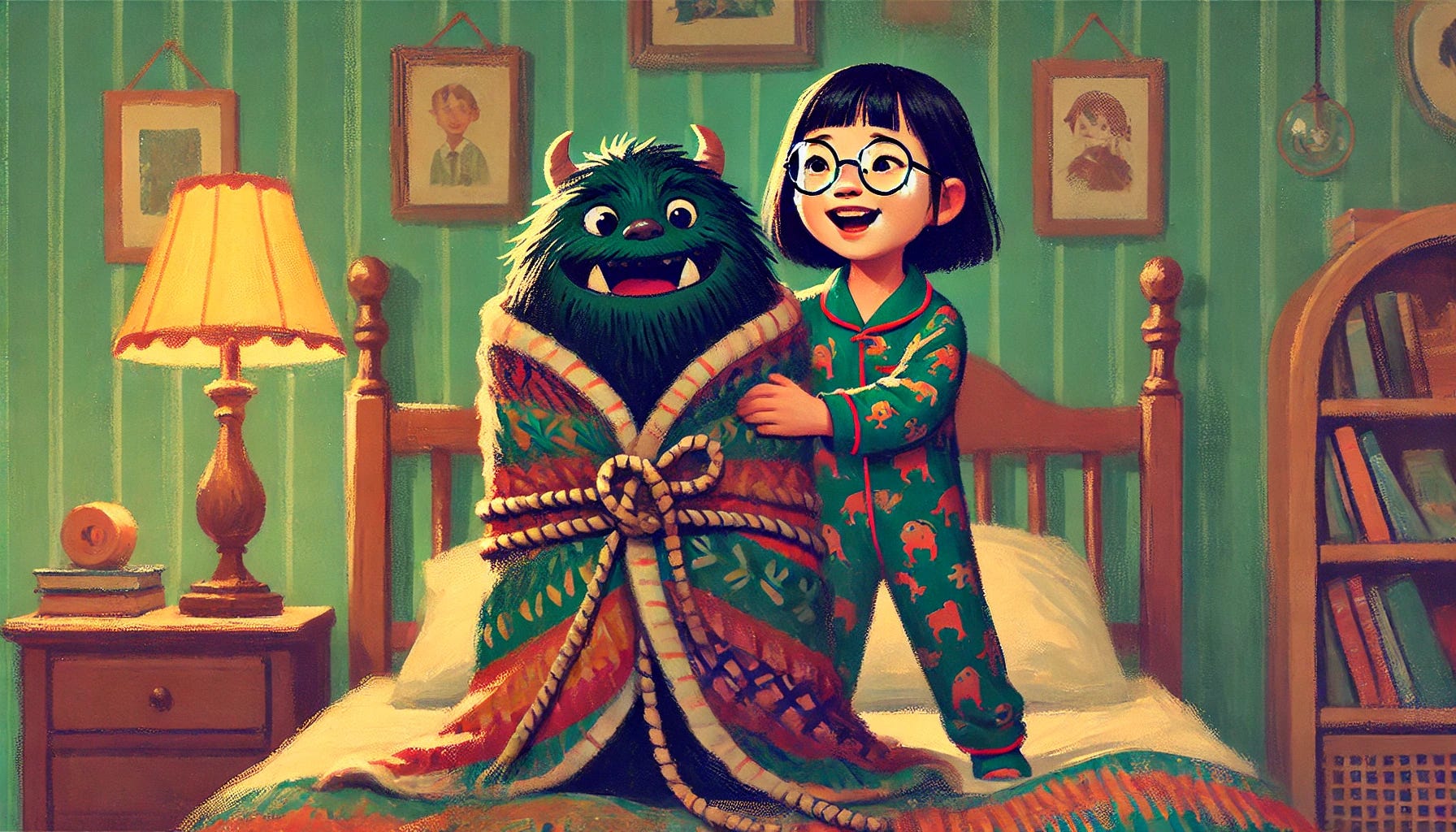
The Bedtime “Monster” issue
Last night, just before bed, my daughter refused to let me close the door. There was a flicker of unease in her eyes. When I gently asked what was wrong, she finally admitted, in a small, hesitant voice, that she was afraid a bad person—or a monster, the way they appear in movies and books—might break in through the window.
My first instinct was the usual one: to reassure her. You’re safe here. Don’t worry. There are no monsters. But then I stopped myself. Rather than bluntly arguing against a fear that felt utterly real to her, I decided it would be better to work within her logic and help her through it from the inside. Denial only makes a child feel more alone. Validation is where safety begins.
So I crouched down, gave her a hug, and let her know her feelings made sense. Then I said, “Okay—if that really happened, what should we do? Do you remember the book we read yesterday, The Princess in Black and The Princess in Blankets?”
My daughter loves blankets. There are always two or three piled on her bed. Pointing at them, I teased, “We could do what the princess does in the book—wrap the monster up tight in these thick blankets, tie it up with rope, and take it to the police station!”
She burst into laughter, then immediately corrected me with great seriousness: “No, Mommy—we have to send them back to Monsterland!”
And just like that, in the middle of that bright, bubbling laughter, the heaviness lifted. The anxiety that had seemed so overwhelming dissolved almost instantly. She stopped worrying about whether the door was shut tightly enough. Wrapped instead in a deep sense of safety—and perhaps a little pride at having figured out how to defeat a monster—she drifted peacefully off to sleep.
Why Logic “Goes Offline” in the Face of Fear
As parents, we often try to use adult logic to correct a child’s feelings. But from the perspective of child development, that effort is often speaking the wrong language entirely.
The amygdala hijack.
When a child is afraid, the brain’s emotional alarm center—the amygdala—is on high alert. In that moment, the prefrontal cortex, which handles reasoning and logic, is temporarily much less available. Saying “There’s no monster” is a logical statement. What the child is experiencing, however, is physiological terror.
The imagination of the preoperational stage.
At five years old, a child is in what Piaget called the preoperational stage. At this age, the boundary between imagination and reality is still porous. In their minds, a monster from a story can feel just as real as the dog next door. To deny the fear is, in a sense, to deny the child’s perception of the world.
A Shift in Parenting: From Denial to Empowerment
If we want to help children move through fear, we need to make a shift in our parenting mindset—from carpenter to gardener. Our job is not to fix a child we see as “too timid.” It is to create the emotional soil in which a sense of agency can grow.
1. Validation: Helping Fear Touch Ground
The first step in creating safety is to get down on a child’s level and acknowledge that the fear is real to them. When you say, “I can see that you’re feeling really worried right now,” that recognition works like releasing steam from a pressure cooker. Once the emotion is seen, the internal alarm can begin to quiet.
2. Co-creation: Giving the Child Back a Sense of Control
Fear is, at its core, a loss of control. In our “monster-catching blanket” scenario, my daughter shifted from being a passive victim to an active problem-solver. The moment she proposed sending the monsters back to Monsterland, she had already reclaimed power in her own mind. The monster was no longer an unspeakable threat. It had become something that could be bundled up, handled, and sent away.
A Courage Toolkit for Parents
Grounded in this psychological logic, here are a few practical ways parents can help:
Use visual play to dismantle fear.**
Invite your child to draw the monster. Then add a ridiculous bow tie, polka-dot socks, or a flowered skirt. Once fear becomes funny, it starts to lose its power.
Create rituals of protection.
A child’s anxiety about doors and windows often comes from a fear of intrusion. Try doing a bedtime “room check” together, or sprinkling a little imaginary “courage dust” around the room. Ritual may seem small, but for the subconscious, it can be deeply reassuring.
Use literature as a safe distance.
As The Gardener and the Carpenter reminds us, parenting is not about constructing a sterile workshop where nothing threatening ever enters. Through stories, we can let children encounter villains and dangers within a safe container—and begin learning how to engage with them.
What Courage Really Means
The ultimate goal of parenting is not to eliminate fear. It is to help a child develop the capacity to live alongside it.
When my daughter stopped obsessing over whether the door was fully closed, it was not because the monsters had disappeared. It was because she now had something else: a thick psychological blanket called validation.
The greatest gift we can give our children is not a world without wind and rain. It is a pair of brave eyes—eyes capable of turning even stormy weather into play.
📚 References & Recommended Reading
Gopnik, A. (2016). The Gardener and the Carpenter: What the New Science of Child Development Tells Us About the Relationship Between Parents and Children. Farrar, Straus and Giroux.
Core Concept: The fundamental shift from “carpentry” (shaping) to “gardening” (nurturing) in modern parenting philosophy.
Piaget, J. (1954). The Construction of Reality in the Child. Basic Books.
Core Concept: Understanding the “Preoperational Stage” of development, where children naturally blur the lines between imagination and reality.
Hale, S., & Shannon, N. (2014). The Princess in Black. Candlewick Press.
Note: The literary inspiration for using specific tools (like blankets) to transform fear into a proactive narrative.
Reader conversation
Join the conversation
Share what this essay brought up for you—your experiences, questions, or a different perspective.