Preface: The Small Figure Lost in the Noise
Last night, just before bed, my house turned into the site of a very ordinary standoff.
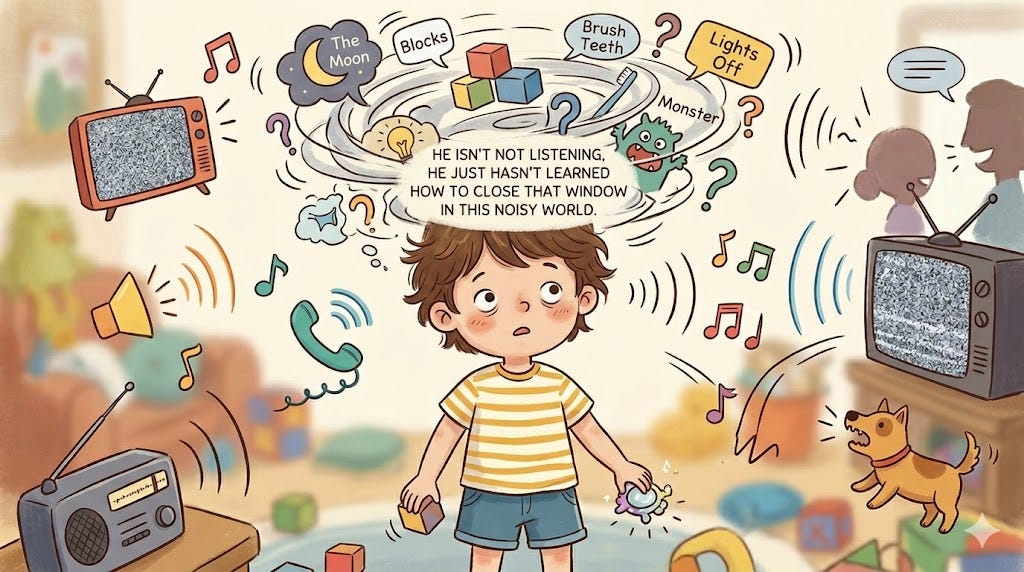
I was doing what parents do at the end of a long day: urging my child toward the finish line. Brush your teeth. Turn off the light. Time for bed. But he was still in motion, like a small spinning top that refused to wind down—first pulled toward the moon outside the window, then suddenly absorbed in a set of blocks he has already played with a hundred times.
I was seconds away from losing patience with what I reflexively labeled distraction when something from Rewire surfaced in my mind: the brain’s filter is not equally developed in children and adults.
That thought changed the whole scene.
He was not defying me. He was not testing boundaries for sport. He was trying to function in the middle of an “information storm”—a storm so constant, so immersive, that adults hardly notice it anymore.
1. Sponge-like Absorption vs. Automatic Filtering
One of the most illuminating ideas in Rewire is that children and adults do not merely pay attention differently. They inhabit different sensory realities.
A child’s indiscriminate absorption:
The young brain is highly plastic, open, and unfinished. It has not yet developed the kind of robust filtering system adults depend on—something neuroscience often associates with the reticular activating system, or RAS. So children do not selectively take in the world the way we do. They absorb it. Everything enters at once: sounds, movement, light, emotion, novelty.
An adult’s efficiency filter:
Adults, meanwhile, are built for triage. We filter constantly and automatically. We tune out the hum of appliances, the chatter in the next room, the visual clutter on the table. This makes daily life manageable. It makes us efficient. But it also means we no longer experience the world with the same raw vividness children do.
2. The Missing Filter: A Beautiful but Heavy Burden
This helps explain something paradoxical about childhood: the same openness that makes children so alive to the world is also what makes the world so overwhelming.
It is their gift:
Because they do not yet filter aggressively, children encounter life in full saturation. They notice the shimmer of light on a wall, the soft movement of leaves outside the window, the barely audible rustle adults have already edited out. Their perception is not shallow. If anything, it is too deep.
It is also their struggle:
But a brain without a strong filter has very little defense against interruption. What we call background noise is often not background to a child at all. The television murmuring in another room, the toy left on the floor, the moon visible through the curtains—these are not minor details. They are competing signals, all demanding attention at once.
What looks like inattention may actually be overload.
3. From “Fixing the Child” to Gently Protecting Them
Once I saw it this way, the emotional temperature shifted immediately.
What I had been reading as misbehavior started to look more like distress. Not dramatic distress, not theatrical distress—just the ordinary, invisible strain of a child trying to organize a world that arrives too loudly.
And that changed my question.
Instead of asking, “Why won’t he listen?” I found myself asking, “What is making it so hard for him to stay here with me?”
That is a very different kind of parenting.
As I wrote before in my notes on the “bedtime monster,” there is very little use in dismissing a child’s perception simply because we do not share it. If the world feels loud to them, then it is loud. If their attention keeps splintering, that splintering is real.
So when a child cannot focus, perhaps our job is not to correct first, but to support first—to help provide the filter their brain has not finished building.
Clear the field of distraction:
Turn off the television before giving directions. Put away the toys still calling for attention. Reduce the number of competing stimuli before asking for focus.
Build connection before redirection:
When a child looks scattered, frustrated, or unable to settle, start with regulation, not instruction. A hug. A calm voice. A simple acknowledgment: “There’s a lot going on right now, isn’t there?” Help their nervous system land before asking their attention to follow.
Conclusion: Be a Gentle Gardener
Rewire reminds us that neural pathways are built through repetition and attention. Children do not simply “grow out of” these struggles by force of will. Their brains are shaped, slowly and relationally, by the environments we help create around them.
Which is why I keep returning to this thought: parenting is less like carving and more like gardening.
We are not here to whittle a child into some ideal shape. We are here to tend conditions. To protect what is still tender. To reduce what overwhelms. To make room for growth.
When we help create an external filter for our children, we are doing more than teaching them to focus. We are honoring the exquisite openness with which they meet the world. We are protecting that still-unhardened, still-curious, still radiant part of them—their sponge-like heart.
So the next time you feel your anger rising, it may help to remember this:
Your child may not be refusing to listen.
They may simply not yet know how to close the window on a noisy world.
References & Further Reading
Vignola, N. (2024). Rewire: Break the Cycle, Alter Your Thoughts and Create Lasting Change.
Gopnik, A. (2016). The Gardener and the Carpenter.
Haidt, J. (2024). The Anxious Generation.
Reader conversation
Join the conversation
Share what this essay brought up for you—your experiences, questions, or a different perspective.