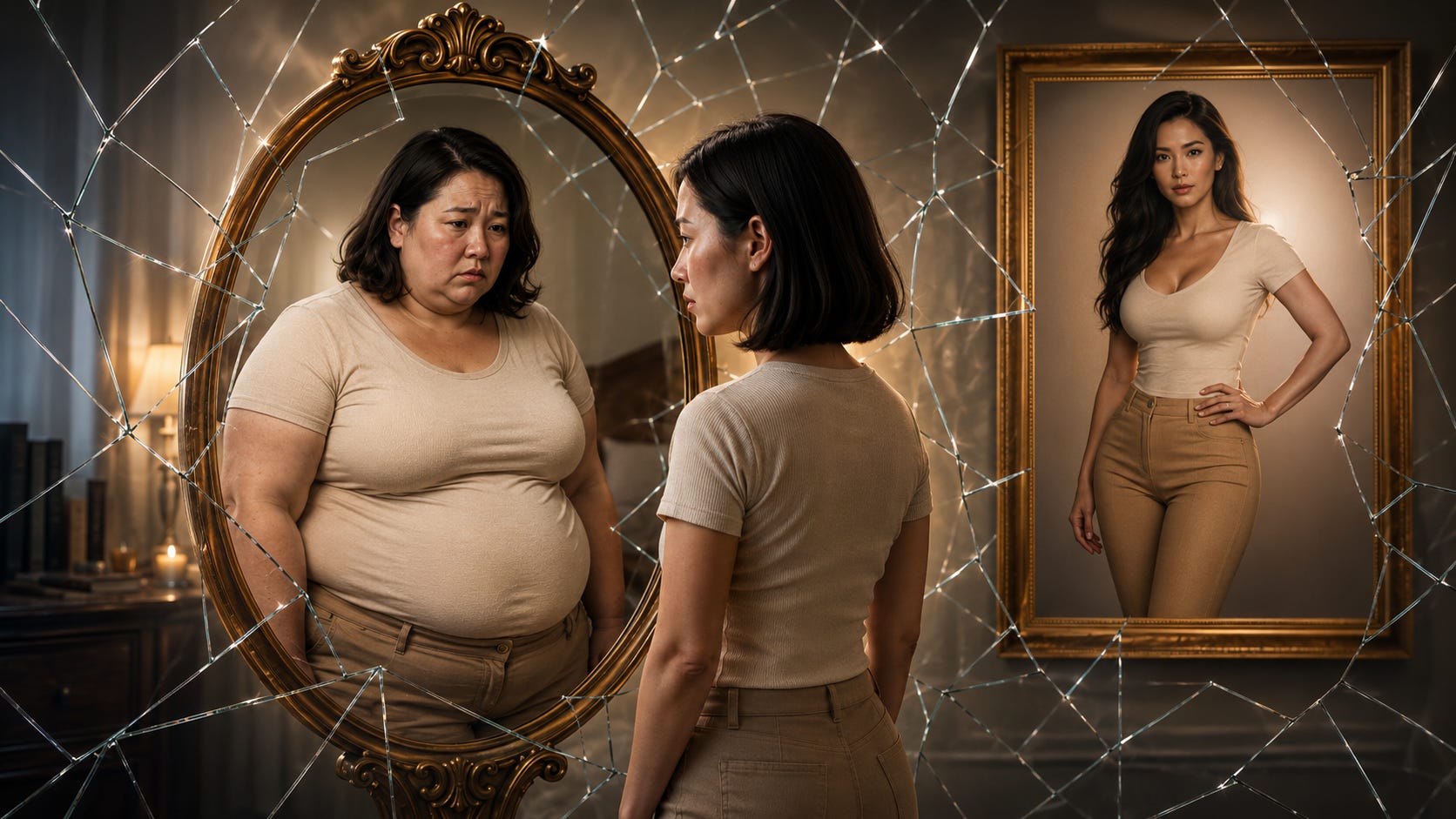
If a fairy appeared before me, wand in hand, and asked:
“I can change one part of your body—painlessly, for free, with no side effects—and make you more beautiful. What would you like to change?”
At thirty-seven, I would smile and say, “Nothing, thank you. I really like the way I look.”
But before I turned thirty, I probably would have gladly accepted her help. I would have asked her to make my face smaller—more specifically, to give me the kind of face celebrated by mainstream Asian beauty standards: a delicate oval, or the classic tapered V-shape.
This change in me came neither too early nor too late. It arrived just as I turned thirty and became a mother. But I know it was not some accidental epiphany. It was the result of years of outer experience meeting years of inner self-exploration, until something finally broke open.
Some people arrive at that breakthrough earlier; some, much later. I feel lucky that I was ready to accept both my outer self and my inner self at the moment I became a mother. That acceptance brought me, on the one hand, a kind of strength I had never known before—something deeply rooted and inward. On the other hand, it left me intensely curious about the forces behind beauty standards and appearance anxiety.
Before I came to the United States, the feature I disliked most about my appearance was my face shape.
Mainstream Asian beauty standards prize small faces: oval faces, V-shaped faces, softly contoured lines, a face so small it can be described as “palm-sized.” My face, by contrast, is more square, with a broad jaw and visible angles. Even if it was not objectively large, it often looked wider than it was. By the standards I had absorbed growing up, my face simply did not count as beautiful.
When I was young, I often heard versions of the same comment: “Your features are nice—your face is just a bit too big.” Over time, I began to carry around a label in my mind: not really pretty.
Two memories remain especially vivid.
The first happened in elementary school. A neighbor said, right in front of me and my older sister, “You girls are all pretty—except number six. Her face is a bit too big.” I was too young then to have what we would call appearance anxiety, but I could still hear the unkindness in it. I remember the discomfort rising through me, from the inside out. I did not blame the neighbor. She was simply voicing her beauty standards in the blunt way many Chinese adults of that generation did when talking about children. Even now, that habit of openly comparing and evaluating children has not entirely disappeared from Asian culture.
The second memory is from high school, when I was at boarding school. One night, my roommates and I were lying in bed talking in the dark. The topic somehow turned to this: if each of us could change one part of our body, what would it be?
When it was my turn, I hesitated for a moment and said I wished my nose were a little higher.
Looking back now, I know perfectly well that everyone expected me to say my face shape. But at that age, there was a streak of pride and stubbornness in me, and I refused to go along with that script. So I dodged it and said “nose” instead.
Sure enough, after I answered, there was a few seconds of suffocating silence in the room. The air grew so awkward it seemed to harden around me. Finally, one of the girls gathered the courage to ask:
“Are you sure you wouldn’t rather make your face a little smaller?”
At that moment, I wanted the floor to open and swallow me.
The real shift did not begin until I came to the United States at twenty-two. That was when both my dissatisfaction with my face and my understanding of beauty began, slowly, to awaken.
When I first arrived in America, I experienced a strong cultural shock, and a large part of it had to do with beauty.
The first thing that startled me was the embrace of tanning in the Western beauty world I encountered. In summer, under the bright sun, people would gather outdoors on purpose to tan, or even go to salons for spray tans, all in pursuit of that honeyed, bronze glow. In China and in many other parts of Asia, the relationship to sunlight is almost the reverse: women carry umbrellas in the heat, wear sun-protective clothing, cover themselves with masks and sleeves, doing everything possible to avoid darkening their skin. That contrast—between desperately wanting something and desperately avoiding it—left me astonished when I first got here.
The second thing I noticed was the celebration of curves in Western pop culture, so different from the thinness-centered beauty standard I had grown up with. Here, beauty often meant fullness, volume, physical presence—not just plump lips, but exaggerated hips framed by an impossibly narrow waist. In the world I came from, by contrast, thinness was treated almost as the only legitimate aesthetic ideal. In China, even the natural widening of a girl’s hips during puberty can become a source of shame, something to be hidden beneath oversized shirts for fear of being labeled “fat.”
The third thing that surprised me was the admiration for angularity. In the Western beauty environment I encountered, strong facial structure—a defined jawline, high cheekbones, visible bone—was often associated with strength, maturity, even vitality. In China, and more broadly in East Asian aesthetics, the preference often runs in the opposite direction: toward softness, youthfulness, and what might be called a childlike delicacy. The popularity of small faces and tapered contours comes partly from the way they soften the skeleton, erasing sharpness and creating an impression of gentleness, harmlessness, and youth.
And so I made an unexpected discovery: the square face I had been criticized for all my life in China might, in another cultural setting, become an advantage.
That was the moment I realized:
The fairy didn’t need to change my face. She only needed to change the frame of reference I was living in.
During my first few years in America, my sense of beauty often swung back and forth. On one hand, I wanted to belong in this new environment, and part of belonging meant learning to see people and things through the aesthetic lens around me. That was one way of entering conversations, understanding others, building connection. But on the other hand, the Asian beauty system lodged deep inside me would keep surfacing—especially when I let my guard down—making my thoughts and reactions contradictory, even to myself.
It was exhausting: suppressing one system while trying to build another.
And yet, in the middle of that exhaustion, I began to feel something I had never felt before: the absurdity of beauty itself. The feeling was almost as unsettling as reading Kafka’s The Metamorphosis. What made it absurd was this: inside a system that is not inherently rational, everyone still obeys it as if it were the most natural thing in the world. Everyone repeats it, enforces it, lives inside it.
And so I began asking myself, over and over:
Why is pale beautiful?
Why is tan beautiful?
Why is thin beautiful?
Why are curves beautiful?
Why is a small face beautiful?
Why are sharp angles beautiful?
Later, I began reading, thinking, and slowly piecing together an understanding. What we treat as self-evident beauty standards often turn out to be shaped by far more complicated cultural forces.
Take skin tone. The differences between Asian and Western preferences for light or dark skin are not, I think, really about color itself. They are about the kind of life that color is imagined to represent. A tan may suggest leisure, vacation, outdoor living, time under the sun. An obsession with fairness may suggest exemption from physical labor, a life lived indoors, protected and refined. What people are really pursuing is not the color, but the classed fantasy behind it: leisure, status, ease. Once I saw that, it struck me as almost ridiculous that our skin could become a billboard for social position.
The contrast between thinness and curves works similarly. Asia’s reverence for slimness seems tied to an ideal of delicacy, restraint, and lightness. Western culture’s fascination with curves often expresses something else: abundance, boldness, presence, a body that takes up space without apology. These ideals may oppose each other, but neither is truth. Each is simply a preference selected and elevated by a particular culture at a particular moment. Once I understood that, these standards stopped feeling like judges presiding over my body. They became what they really were: a few dotted lines drawn on different cultural axes—real enough to influence us, but not sacred.
As for face shape, I came to feel that different cultures are often choosing between two different aesthetic values: youthfulness and maturity. East Asian beauty standards tend to favor smaller, rounder, softer faces, carrying an undercurrent of innocence, harmlessness, and protectedness. Western beauty culture, by contrast, often grants angularity and visible bone structure a sense of maturity, independence, force, and vitality. Our bones never changed. What changed was the meaning culture assigned to them. Once I understood that, I was finally able to let go of my resentment toward my square face. It was never an inherent flaw. It had simply been placed inside a coordinate system that worked against it.
So no beauty standard—on either side—has any real claim to genetic superiority. More often, beauty is simply a local preference shaped by history, class, consumer culture, and collective fantasy. At the root of many beauty ideals lies the same principle: scarcity.
That thought reminds me of diamonds and bird’s nest soup.
Diamonds are expensive not simply because of what they are, but because for generations people have wrapped them in stories—love, status, taste—while supply was carefully controlled to preserve their aura of rarity. Bird’s nest is similar. Its value comes partly from how difficult it is to harvest and prepare, from the elaborate cultural narrative surrounding it. Strip away those stories, and neither one is quite as magical or irreplaceable as we are taught to believe.
Sometimes beauty standards work the same way.
A tiny face. An hourglass figure. These traits are elevated not necessarily because they are inherently superior, but because they are less common and therefore easier to turn into desirable forms of scarcity. Once scarcity is given value, anxiety follows close behind.
What continues to puzzle me is this: when it comes to other forms of life, our aesthetic sensibility is often far more generous.
We admire flowers in every color and shape. We adore cats and dogs with all kinds of faces, bodies, coats, and proportions. Why, then, are we so narrow, so rigid, so cruelly specific when it comes to human beauty?
Looking back now, the hurtful comments once made about my face no longer carry much weight. They have become almost light enough to mention in passing. For a long time, I thought those experiences had at least pushed me in a useful direction: because I knew appearance was not my advantage, I spent less of my adolescence investing in it, and turned instead toward books, toward building an inner life.
But later, after reading about developmental trauma and emotional healing, I came to understand that perhaps I was also just trying to make sense of pain. Human beings are wired to give meaning to our wounds, to tell ourselves stories that make them sting less.
So no—I will not thank the biased comments, or the experiences that wounded me. Pain in itself is not something to be grateful for.
What I am grateful for is the self who once stood inside a shattered beauty system and still kept trying, piece by piece, to gather herself back together.
I am grateful for the self who kept asking questions in the midst of confusion, who tried to stay awake and clear-eyed amid cultural dissonance. It was that unwillingness to surrender too easily that finally led me to my own truth.
I am also grateful that I had the chance to live inside two radically different beauty cultures—and, through that, to awaken.
And once I became a mother, that awakening took on another layer of meaning.
I no longer worry about whether my daughter will grow into a “standard” kind of face. Because I know that instead of handing her a pair of scissors and teaching her how to cut herself down to fit, I would rather teach her how to recognize the strength in her own bones.
I hope the beauty she sees is not a locked and rationed resource, but a wild and boundless field. In that field, nothing is trimmed into uniform shapes. There are no ornamental plants forced into compliance—only grasses and trees growing freely according to their nature.
I hope she—and all women—will come to understand that beauty is not a competition to squeeze through a narrow gate. It is a grand adventure of inward discovery and outward expansion.
True freedom is not finally meeting a standard.
It is no longer handing yourself over to be judged by one.
Reader conversation
Join the conversation
Share what this essay brought up for you—your experiences, questions, or a different perspective.