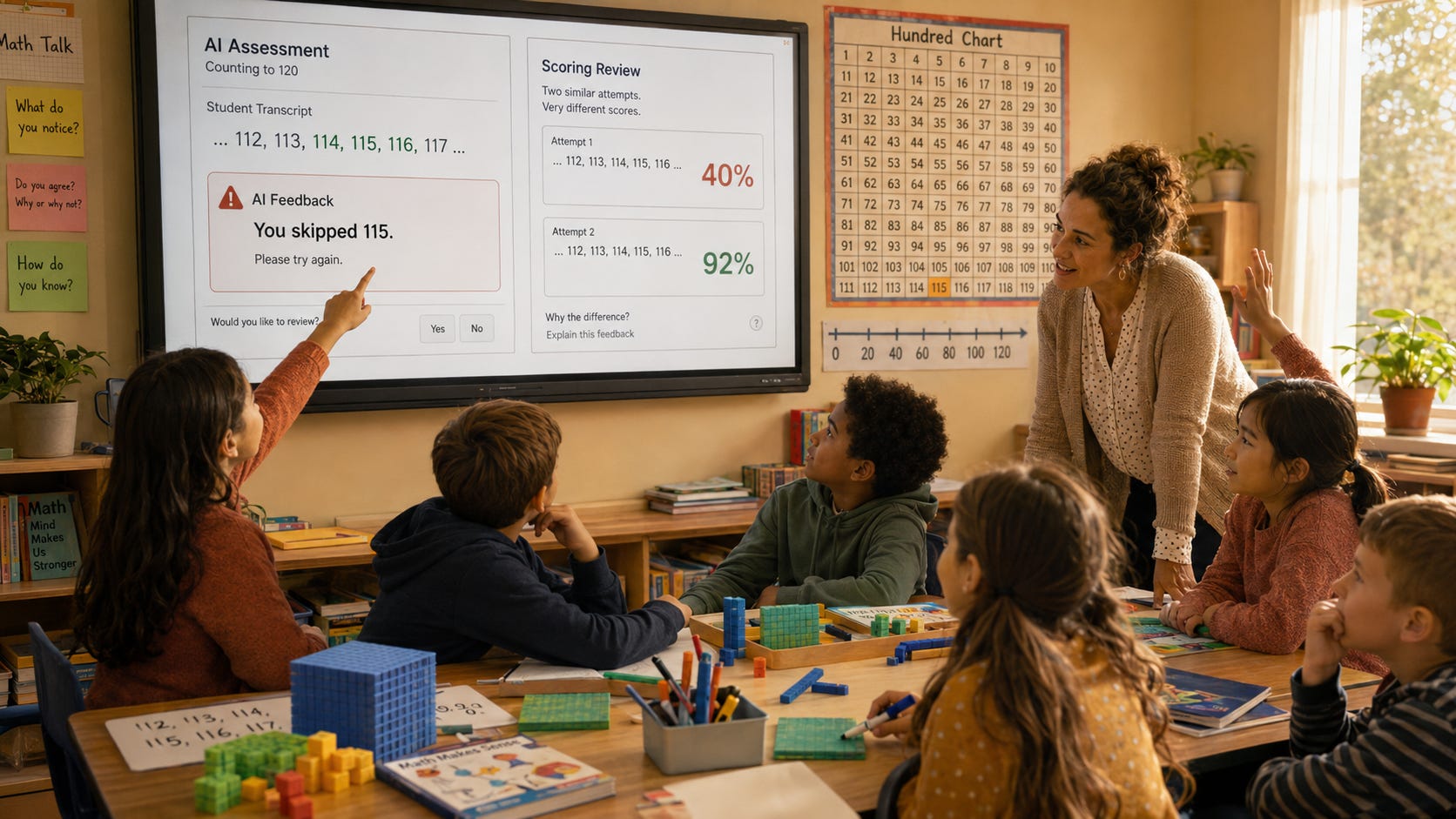
“Huang Laoshi, it’s lying!”
The voice came from across the room, sharp with frustration.
A few seconds later, another student raised a hand. Then another.
Within minutes, my math lesson had turned into something unexpected: a room full of children challenging an AI system.
As an elementary school teacher, I have always been open to bringing new technologies into my classroom. I appreciate tools that make instruction smoother, feedback faster, and assessment more precise.
But that day, the tool failed.
And because it failed, my students learned something more important than the lesson I had planned.
When the AI Got It Wrong
The activity was simple: students would use an AI feedback platform to assess their ability to count from a random number up to 120.
This particular tool had always seemed reliable.
But that day, it behaved less like a helpful assistant and more like a confused, stubborn judge.
Soon, the room filled with protests.
“Huang Laoshi, it says I skipped 115, but I didn’t.”
“It says I counted 98 twice. It’s lying.”
“It asked me to explain my thinking, but it’s just counting. How do I explain that?”
I walked from desk to desk, checking tablets.
The AI had misheard numbers. It had marked correct answers wrong. It had even offered confident feedback for mistakes the children had never made.
Then I noticed something more troubling.
Two students had given nearly identical responses. Their pacing was similar. Their accuracy was similar.
One received a perfect score.
The other barely passed.
That was the moment the problem stopped feeling like a glitch.
It became a lesson.
From Being Scored to Thinking Back
I stopped the activity.
Instead of asking students to keep practicing, I projected several of the AI’s strange scores and comments onto the board.
Then I asked:
“What do you notice?”
The room changed.
Students who had been embarrassed by their scores began looking more closely. They compared the feedback with what they had actually said. They listened for evidence. They noticed contradictions.
One student pointed to the transcript and said, “But I said that number. You can hear it.”
Another asked, “If we counted the same way, why did only one of us lose points?”
They were no longer simply being assessed.
They were assessing the assessor.
Jonathan Haidt has described our current moment as part of a larger rewiring of childhood, one in which children increasingly grow up mediated by screens, platforms, and algorithms. I thought of that idea later, after the lesson was over.
Because in that moment, something important happened.
My students did not surrender their judgment to the screen.
They used their judgment to question it.
The Most Valuable Glitch
As a teacher, I found myself strangely grateful.
In The Gardener and the Carpenter, Alison Gopnik writes about the difference between trying to shape children like products and creating environments where they can grow.
That day, the AI’s mistake became part of the environment.
A weed, maybe.
But a valuable one.
It disrupted the quiet assumption that technology is always more objective than we are. It gave students a reason to ask whether a machine could be confident and still be wrong.
The lesson was no longer only about counting to 120.
It had become a lesson in evidence, fairness, and intellectual courage.
What We Really Need to Teach
AI literacy does not begin with learning better prompts.
It begins with learning to say:
“Wait. That doesn’t make sense.”
In an age when AI is entering more and more corners of childhood, children need more than access to tools. They need practice questioning them.
They need to know that a score is not always the truth.
A report is not always the whole story.
A confident answer is not always a correct one.
The children we need to raise are not merely children who can follow an AI-generated report.
They are children who, even after receiving an absurdly low score from an algorithm, can confidently say:
“No. I was right. It was wrong.”
Because judgment does not live in the machine.
It lives in the child who knows how to question it.
References
Gopnik, A. (2016). The Gardener and the Carpenter: What the New Science of Child Development Tells Us About the Relationship Between Parents and Children.
Haidt, J. (2024).The Anxious Generation: How the Great Rewiring of Childhood Is Causing an Epidemic of Mental Illness.
Image generated by AI.
Reader conversation
Join the conversation
Share what this essay brought up for you—your experiences, questions, or a different perspective.