At school, I am usually the calm one.
When students are overwhelmed, when something unexpected happens in the classroom, when emotions spill over, I can often remain steady. I know how to lower my voice, slow the moment down, and help everyone find their footing again.
Then I come home.
At home, my five-year-old daughter and three-year-old son can carry me to the edge of my patience over things that seem almost absurdly small. And yet, it is often in those least graceful moments—when I am tired, embarrassed, and unsure of what to do—that they show me something I could not see before.
Dinner a few nights ago was one of those moments.
My daughter was lying facedown on the living room floor, sobbing.
She had not fallen. She had not fought with her brother. Nothing had happened, at least not in the way adults usually define something happening.
She wanted a marshmallow cookie.
And she did not want to eat the small piece of stewed chicken on her plate.
She ran back and forth between the dining table and the living room several times. Each time she approached the chicken, she stopped as though she had reached the edge of a cliff. Then she would remember that her brother might get a cookie while she had to watch, and the grief of that imagined future would send her running away again.
Finally, through tears, she cried out:
“I don’t want to choose! It’s too hard! You choose for me!”
Something in that sentence stopped me.
Because in that moment, I began to understand that she might not have been the only person struggling to bear the weight of the choice.
01
Between a Piece of Chicken and a Cookie
Our family has a rule at dinner: the children need to taste one bite of each food on their plates before receiving a small dessert.
We call these tastes “Brave Bites.”
The rule was never meant to force them to finish food they disliked. We wanted to encourage them to remain open—to experience different ingredients, textures, and ways of cooking before deciding that something belonged forever outside the boundaries of what they would eat.
My daughter is a selective eater, especially when it comes to meat. She will sometimes tolerate roasted chicken legs. Stewed chicken, however, lives firmly inside what she considers forbidden territory.
That night’s dessert made the decision unusually painful.
One of my husband’s coworkers had baked marshmallow cookies for a gathering, and we had brought a few home. They were special, unfamiliar, and not likely to appear again anytime soon.
My daughter looked at the chicken on her plate, and her whole face folded inward.
“I don’t want to eat this. It’s too yucky.”
I reminded her, “Whether you eat it is your choice. But if you want one of the cookies, you need to take one Brave Bite first.”
At the word cookie, her eyes brightened.
Then she looked back at the chicken, and the light disappeared.
“I don’t want the chicken,” she said, “but I want a marshmallow cookie!”
“I know,” I told her. “But every choice has a consequence.”
Beside her, her younger brother took a bite of chicken without hesitation. He lifted his chest proudly and announced:
“Mommy, I already tried it!”
My husband added, “If you choose not to try it, you will also have to accept that your brother gets a cookie later and you don’t.”
Looking back, I can see how much heavier those words may have made the moment.
She was not only facing the chicken. She was also being asked to imagine her brother’s pleasure and her own exclusion. She could already see him holding the cookie she wanted while her own hands remained empty.
Her face tightened.
Then she shouted:
“I don’t want to choose! It’s too hard! You choose for me!”
“This is your choice,” I said. “Mommy can’t choose for you.”
The moment I said it, everything she had been holding inside seemed to break open.
She slid from her chair and collapsed onto the living room floor. She cried so hard that her shoulders shook. After a while, she stood up and returned to the table. She stared at the chicken as though she might force herself across the distance between fear and action.
But she could not.
One look, and she broke down again.
She ran back to the living room and fell to the floor.
Her brother, pulled into the storm, covered his ears and began to scream.
My husband and I stood nearby while our own emotions rose—the disappointment, the irritation, the helplessness, all of it crowding into the room.
02
After I Locked My Mouth
I wanted to shout:
“Is this really necessary? Both of you, go to your rooms!”
The words were already inside me.
But some last fragment of self-control held them back.
I knew I had reached the edge of my own capacity. If I continued speaking, I would probably not say anything useful or wise. I would simply make my voice louder until the chaos stopped—not because the children had learned anything, but because I could no longer tolerate the discomfort of the moment.
I looked at my husband and signaled for him to leave the room for a while and calm down.
Then I used every bit of strength I had to lock my mouth and nail my body to the chair.
No criticism.
No urging.
No more explanations of the rule.
I just sat there.
From the outside, perhaps I looked calm.
Inside, I was full of doubt.
I worried that my daughter’s selective eating might affect her growth or health. I worried that a rule we had created to encourage openness might instead deepen her resistance to food.
I could not tell whether I was giving her an opportunity to practice making a difficult choice or simply refusing to admit that our rule might need to change.
And I had no confidence that she would choose what I wanted her to choose.
I only had a faint sense that some abilities do not arrive after a child feels ready. They grow through the experience of being unready—through imperfect attempts, failed attempts, and moments that do not look like progress while they are happening.
But when your child is falling apart in front of you, that belief offers very little comfort.
I watched her move between her desire for the cookie and her fear of the chicken. She approached, retreated, approached again.
I wanted to relieve her pain.
But I also knew that choosing for her would not erase the reality she was resisting. Whether I told her to eat the chicken or gave her permission not to, I could not make both of her wishes come true.
She could not completely avoid the chicken and still receive the cookie without cost.
Later, when I thought again about her plea—You choose for me—I understood Deci’s ideas about autonomy in a more immediate way.
We often talk about giving children choices as though choice itself were a gift: light, empowering, and unquestionably good. We imagine that if we return the decision to the child, independence will naturally follow.
But choice can also hurt.
For a five-year-old, choosing sometimes means accepting that two desires cannot both be satisfied. It means discovering that freedom does not remove loss.
Autonomy is not simply the ability to do whatever one wants. Nor is it a parent handing every decision to a child and stepping away.
It is something quieter.
It is the feeling that even when rules and limits remain, I still participate in what happens next. My actions are not entirely pushed into motion by someone else.
That evening, I think that was what I was trying to preserve.
Still, there is no clean and permanent line between holding a boundary and respecting a child’s autonomy. There was no theory that could tell me exactly what to do in that room, with my daughter crying on the floor and a piece of chicken cooling on the table.
So I sat there.
I stayed with her.
And I stayed with my own uncertainty.
03
“Mommy, Feed It to Me”
I do not know how long it took for the storm to pass.
Eventually, my daughter stood up. She wiped her face with her hands. Her eyes were swollen and red, and thin tracks of tears remained on her cheeks.
I did not try to persuade her again.
I began clearing the table.
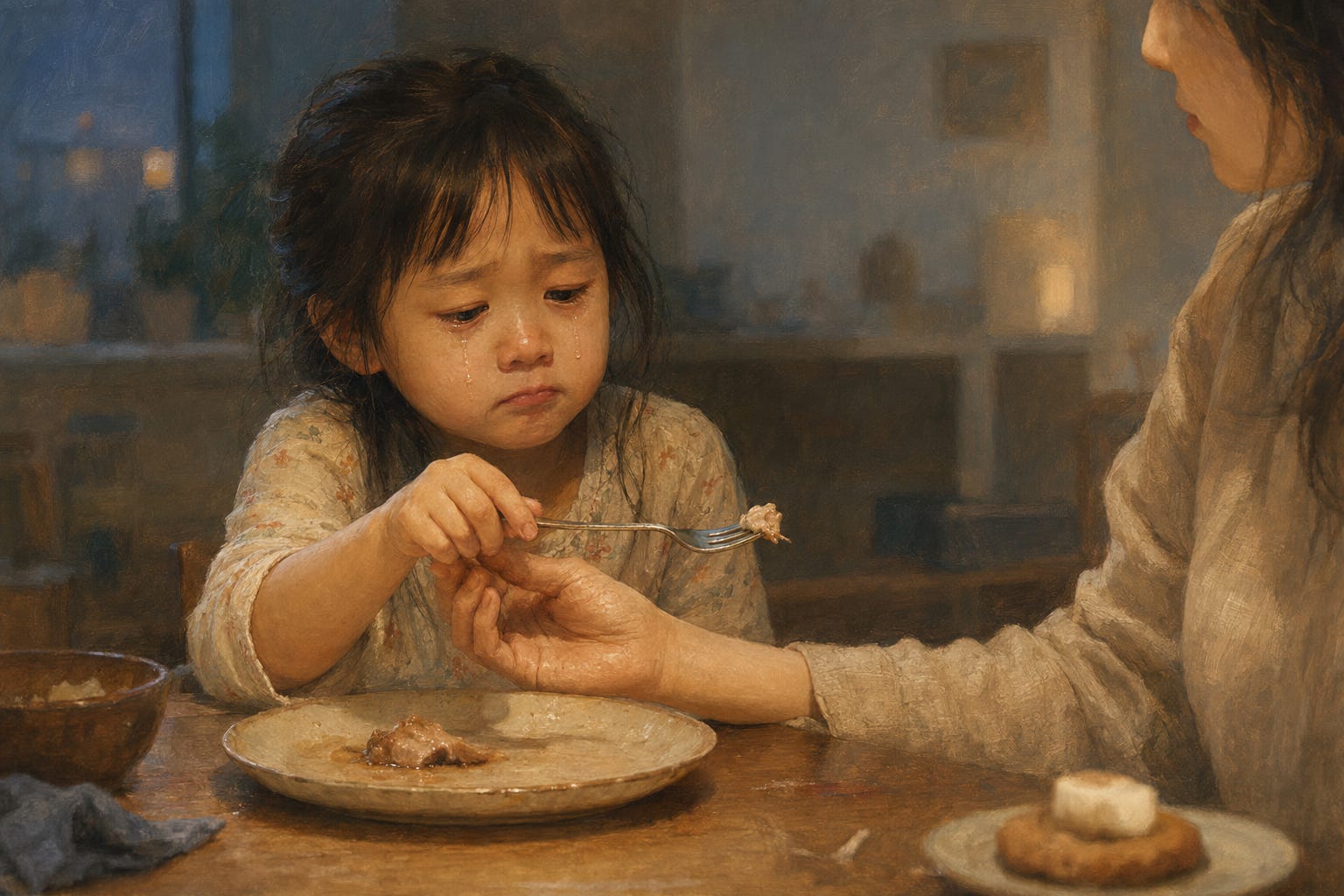
As I placed a plate in the sink, I heard her voice behind me, so soft that I nearly missed it.
“Mommy, feed me the chicken.”
I turned around.
“You want to try it?”
She was still pouting. Her answer seemed to offer herself a small place to hide.
“I’ll only try it if you feed me.”
I accepted the opening immediately.
I picked up a tiny piece of chicken with a fork and held it to her mouth.
She had not asked me to remove the rule. She had not asked me to decide whether she should eat.
Instead, she had changed the shape of the challenge.
She had taken something impossible and made it barely possible.
The decision would remain hers.
The bite, we would complete together.
She opened her mouth and bit off a small piece.
A few seconds later, she spat it out.
The chicken fell onto the carpet.
She froze.
Her face filled with guilt and fear as she looked at me.
Her expression seemed to ask:
Did I ruin everything?
Does it still count?
Can I still have the cookie?
I did not scold her.
I handed her a paper towel.
“It’s okay,” I said. “Just wipe it up. You were really brave today because you were willing to try.”
She had not conquered stewed chicken.
That one bite did not transform her into an adventurous eater.
She had not even swallowed it.
But after crying, running away, returning, and retreating again, she had found a path she could take.
Bandura’s theory of self-efficacy later helped me understand the significance of that small movement.
We do not always act because we already believe we are capable. Often, belief comes afterward. It grows from the experience of discovering:
I thought I could not do this at all, but I managed one small part of it.
That kind of confidence is not an abstract statement—I believe in myself.
It is memory.
It is evidence.
It is the knowledge that once, when something felt impossible, I still moved a little closer.
My daughter did not lift the fork by herself. She did not display the polished, upright courage adults often prefer to recognize.
She cried.
She ran away.
She needed her mother.
Then she spat the food onto the floor.
But none of those things canceled the attempt.
She learned that she could be afraid and still try.
She could collapse and begin again.
She could borrow strength from someone else without surrendering the decision entirely.
I once might have understood capability as the ability to complete something alone.
That night, my daughter reminded me that asking for help is also a capability. So is changing the method. So is reducing a challenge until it becomes small enough to survive.
In the end, she received the marshmallow cookie.
She took her brother by the hand, and the two of them ran outside to play. They ate their cookies together as though the thunderstorm inside our house had never happened.
I remained beside the table, surrounded by dishes, unable to move on so easily.
04
Children Endure Frustration. Parents Do Too.
My daughter was not the only one who had to endure frustration that night.
She had to face the impossibility of satisfying both of her desires. She wanted to avoid the chicken. She wanted the cookie.
Reality would not allow both.
I had to face something different.
I had to watch her suffer without immediately removing the difficulty simply because her pain made me anxious, impatient, or heartbroken.
We talk often about helping children become resilient, as though resilience were a subject they must study while adults stand nearby and teach.
But a child’s ability to move through frustration may depend, in part, on whether the adults around her can tolerate the chaos long enough for her to find a way.
Can we resist deciding that a rule is wrong simply because a child cries?
Can we hold a rule without using it to dismiss the child’s pain?
Can we stop ourselves from rushing, judging, and interpreting every collapse as disobedience?
That night, my daughter was practicing how to bear a choice that could not give her everything she wanted.
I was practicing how to bear the sight of her not yet knowing how to bear it.
I do not take this experience as proof that Brave Bites are the correct solution to selective eating.
Theory helped me interpret what happened. It did not resolve all my doubts.
The next time, I will still need to watch carefully.
Is her resistance a familiar refusal of something she does not yet know? Or is she experiencing a stronger sensory discomfort that I do not fully understand?
Is the rule gently widening the boundaries of what she can tolerate? Or is it adding anxiety that does not need to be there?
Deci’s theory of autonomy cannot prove that every rule is reasonable. Bandura’s theory of self-efficacy cannot prove that every form of persistence is beneficial.
Life, when it lands on the body of a crying five-year-old, is never as orderly as theory makes it appear.
I also have to admit that because my daughter eventually took the bite, it was easy for me to call the evening a story about resilience.
Had she refused until bedtime, perhaps I would only have felt defeated. Perhaps I would have decided that the entire approach had failed.
That possibility leaves me with another question:
Is resilience visible only when someone eventually does the difficult thing?
Or might it also exist in the unfinished process—in approaching and retreating, in grieving what cannot be had, in asking for help, and in preserving the possibility of trying again after failure?
I still do not know.
But that evening showed me at least this:
Allowing a child to encounter frustration does not mean abandoning her inside it.
An adult can refuse to make the choice for her and still extend a hand.
We can hold a boundary for the moment while remaining willing to ask whether that boundary should change.
A child’s resilience does not mean that she never cries, never retreats, and never needs another person.
Perhaps resilience is less beautiful than that.
Perhaps it is simply this: she is afraid, she moves slowly, she borrows a little strength from someone she trusts—and still, somehow, she inches half a step forward.
And perhaps the work of parenting is not to clear every frustration from a child’s path.
Perhaps it is to stay connected when she struggles, to offer help without taking over, and to restrain the part of ourselves that wants to make her pain disappear simply because we cannot bear to witness it.
References
Bandura, A. (1977). Self-efficacy: Toward a unifying theory of behavioral change. Psychological Review, 84(2), 191–215. https://doi.org/10.1037/0033-295X.84.2.191
—The discussion of how a person’s sense of efficacy can develop through direct experience and successful performance draws on Bandura’s theory of self-efficacy.
Deci, E. L., & Ryan, R. M. (2000). The “what” and “why” of goal pursuits: Human needs and the self-determination of behavior. Psychological Inquiry, 11(4), 227–268. https://doi.org/10.1207/S15327965PLI1104_01
—The discussion of autonomy, competence, and self-directed motivation draws on Deci and Ryan’s Self-Determination Theory.
Reader conversation
Join the conversation
Share what this essay brought up for you—your experiences, questions, or a different perspective.