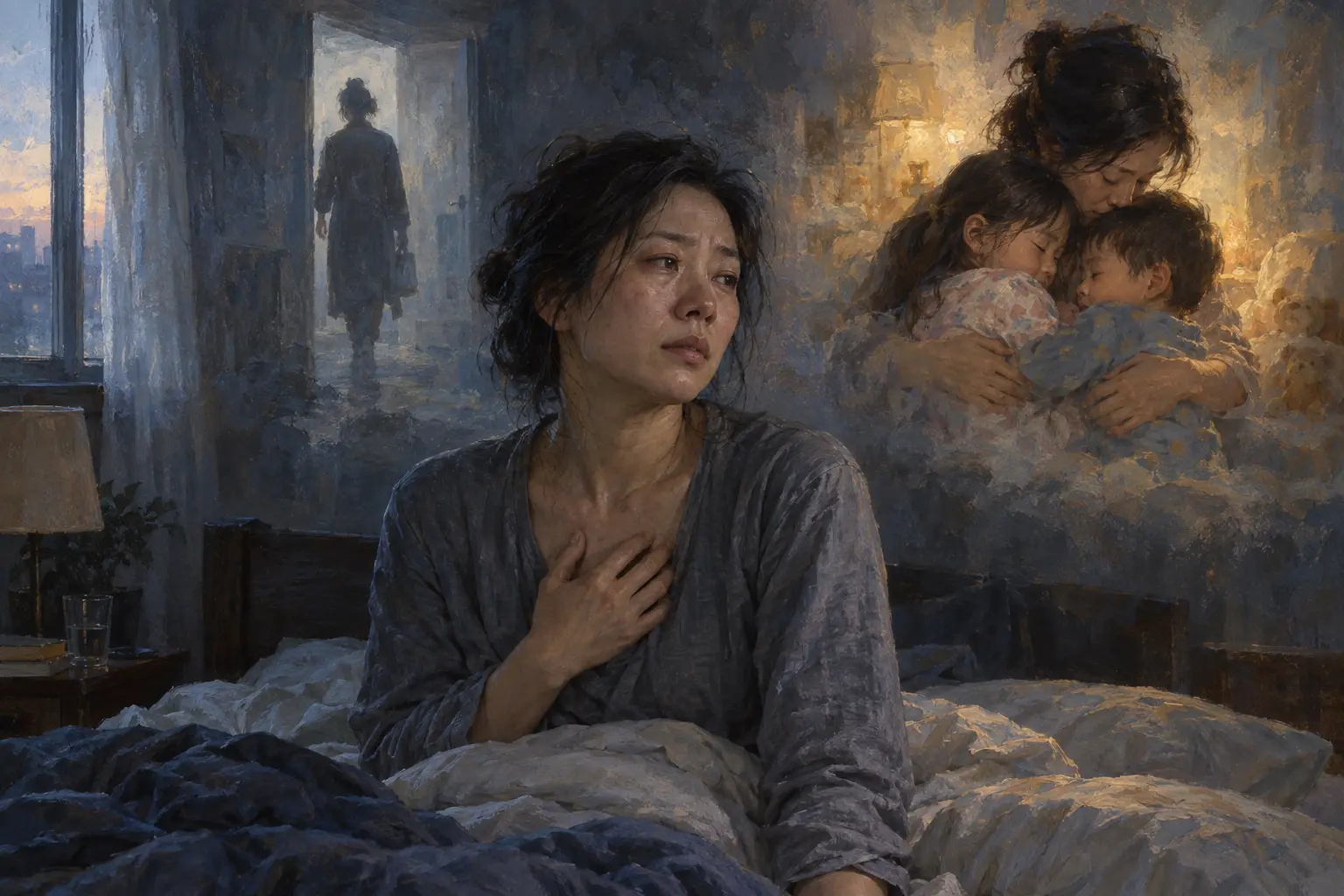
Not long ago, I had two dreams only a few nights apart.
In the first, I left my husband and children.
I can no longer remember exactly what happened. All I remember is that, in the dream, I had reached the very end of my strength, as if something inside me had finally broken.
So I walked away without looking back.
No explanation. No arrangements. I didn’t even turn around to look at my children.
I just left.
When I woke up, I was lying in my own bed, but the exhaustion from the dream felt startlingly real, as if my body had actually been through a long escape.
I didn’t get up right away. I stayed in bed for a long time, slowly sorting out where the dream ended and reality began. Only when that feeling of complete depletion started to recede did I fully come back to myself.
Then another kind of unease set in.
Deep down, did I really want to get away from them that badly?
A few nights later, I had a second dream.
In it, I was the kind of mother I could only describe as “evil.”
I had done something to hurt my children. I no longer remember what it was. I only remember the overwhelming guilt.
Then my children began to take revenge on me.
The entire dream was filled with conflict, anger, and punishment.
At the end, for reasons I still don’t understand, everything suddenly went quiet.
I held them and sobbed so hard that my whole body shook, saying over and over:
“I love you.”
When I woke up, the details of the dream began to fade almost immediately. The people, the conflict, everything that had led up to it blurred like an ink painting touched by water, its edges bleeding into one another.
But the heartbreak didn’t disappear with them.
It remained so vivid that it almost seemed to have weight.
Without thinking, I placed a hand over my chest, as if trying to understand what had happened there. I lay still and took several deep breaths before I could slowly sit up.
The dream was gone, but the emotion was still in my body.
Having two dreams like that so close together deeply unsettled me.
In one, I abandoned my family.
In the other, I became someone who hurt her children.
I couldn’t help treating the dreams as evidence.
Was the “bad mother” in those dreams the truest part of me, hidden somewhere underneath?
Did the thoughts that occasionally crossed my mind during the day—I just want to be alone. I don’t want anyone to need me right now—carry more darkness than I wanted to admit?
But when I looked away from the dreams and toward my life, they no longer seemed to have come from nowhere.
Since the new school year began, my life has felt as if someone wound it too tight.
During the day, I teach kindergarten and first grade.
Nearly forty children. Lessons, classroom management, communication with families, and all the small school matters that appear without warning. I spend almost the entire day responding to someone:
“Ms. Huang, I need your help.”
“Ms. Huang, he just pushed me!”
“Ms. Huang, I don’t know what to do.”
When I come home, the needing doesn’t stop.
There are my own two children: dinner, baths, cleaning up, spending time together, and the bedtime routine that looks simple but always takes much longer than expected.
I also keep stubbornly trying to save a little space for my writing.
That space is precious to me. Not because the work is especially important or grand, but because when I write, I am not only a teacher. I am not only a mother. I am not someone’s caretaker.
I get to be myself again.
So by the time I finally get both children into bed each night, I often have no words left.
The moment I close their bedroom door, a sense of relief—almost extravagant in its intensity—rises inside me.
Finally.
Now, finally, a little piece of time belongs to me.
I can read a few pages, write something, or finish the work I couldn’t get to during the day. Even if I do nothing at all, I can sit quietly in a room for a while.
And then the door opens again.
“Mom, I can’t sleep.”
“Mom, I need some water.”
“Mom, I have one more question…”
The first time, I can still patiently walk them back to bed.
The second time, my jaw begins to tighten.
By the third, I can sometimes feel the irritation rising before thought has a chance to catch up, as if my body is already shouting:
Enough.
I truly have nothing left to give today.
Sometimes I manage to hold it in.
Sometimes I don’t.
Once I snap, and the children are finally lying quietly in bed, regret rushes in.
The hardest part isn’t even thinking, I handled that moment badly.
It is the quieter, sharper question underneath:
Am I becoming the kind of mother I never wanted to be?
I know parents don’t need to be perfect.
As a teacher, I can easily tell parents that children don’t need an adult who never makes mistakes. They need a relationship in which mistakes can be repaired and connection can be restored.
But when it comes to me, that knowledge often fails.
I still expect myself to be more patient, more steady, more mature.
Only later did I begin to realize that what made me so angry on those nights was never simply that my children would not go to sleep.
Every time the door opened, it interrupted more than my reading or writing.
It interrupted a small hope that had just begun to rise:
Finally, it’s my turn.
So when the door opened again, perhaps what truly broke me was another question:
Why does everyone get to keep needing me, while I’m not allowed to need even a little time that belongs to me?
It was in this state that I had those two dreams.
At the time, I had no idea how to understand them.
I only knew that they frightened me.
In the middle of that fear and confusion, I picked up Matthew Walker’s Why We Sleep again.
Its discussion of REM sleep and emotional memory didn’t explain the dreams for me. But it did allow me to loosen my grip on one terrifying assumption:
What we do in our dreams is not necessarily a confession from some hidden self.
Some studies suggest that dreams draw on emotionally significant experiences from our waking lives. Once those experiences enter a dream, they aren’t replayed exactly as they happened. They may be broken apart, rearranged, exaggerated, or made strange.
That doesn’t mean every dream contains a message waiting to be decoded. Nor does it tell me exactly what those two dreams were “processing.”
But it gave me another possibility:
Maybe those dreams weren’t showing me how bad I was.
Maybe they were taking the exhaustion and guilt I couldn’t admit during the day and pushing them to their farthest edges.
With that possibility in mind, I returned to the first dream.
Why did I have to leave?
At first, all I could see was a mother abandoning her husband and children without looking back.
Now I began to wonder if what I wanted to escape was not my children themselves.
Maybe I wanted to escape the version of myself who had to be useful, patient, and responsible at all hours.
The person who was always on duty.
In real life, I would never simply walk away. Even the thought I don’t want to do this anymore feels like something I’m not allowed to take seriously.
So the dream carried that exhaustion to its most extreme conclusion.
It let the depleted version of me actually leave.
For the first time, I understood:
Of course I love them.
But loving someone doesn’t automatically erase exhaustion.
A person can love her children deeply and still have moments when she wants to disappear from every role she inhabits.
These things do not contradict each other.
When I returned to the second dream, the “evil mother” was no longer the only thing I noticed.
Another detail began to trouble me:
Why did my children need to punish me?
I sat with that question for a while before realizing that the retaliation in the dream felt a lot like what I do to myself when I’m awake.
After I lose my temper with my children, the punishment that continues rarely comes from their response.
It comes from me.
I replay my tone of voice over and over. I imagine the wounds my anger might have left behind. Then I judge myself against an almost merciless standard:
A truly good mother would never behave this way.
The dream had turned that internal trial into a drama.
I hurt them.
They punished me.
It was as though I had borrowed my children’s hands to punish the version of myself who had disappointed me.
Until, eventually, we were all exhausted.
I held them, shaking with tears, and told them again and again:
“I love you.”
Only later did I notice that, in the dream, I hadn’t rushed to apologize.
Of course, if I hurt my children in real life, I still need to take responsibility, apologize, and repair our connection.
But at the end of that dream, something else seemed even more urgent.
I wanted them to know:
No matter what had happened before, my love for them had never changed.
When I thought about that moment again, a question I had never asked myself before suddenly surfaced.
If I wanted my children to know that I would never withdraw my love just because they had done something wrong—
what about me?
Could I make a mistake without immediately withdrawing love from myself?
The question caught me off guard.
I can accept my children when they cry, make mistakes, or lose control. I know those moments don’t suddenly make them unworthy of love.
They can do something wrong and still be the children I love.
But for myself, I seem to follow a different set of rules.
When I’m patient, I can tell myself I did a decent job that day.
When I lose my temper once, I want to erase everything I did well.
When I keep my emotions under control, I reluctantly allow myself to believe I’m a good mother.
The moment I lose control, the familiar voice returns:
Why are you doing this again?
Don’t you know better?
Aren’t you a teacher?
Why can’t you do this for your own children?
And this harshness doesn’t appear only after I lose my temper.
I remind my children that they should rest when they’re tired, and that they can pause when their emotions become too much. But when it comes to me, my instinct is usually:
Just keep going a little longer.
After spending the whole day surrounded by countless voices, I finally reach the quiet of the evening—only to start thinking about everything I still haven’t finished.
Even when I am too tired to speak, I believe I should be more patient.
Even when all I want is ten minutes alone, part of me wonders whether that is too much to ask.
Even writing—the place where I feel most like myself—must wait until everyone else’s needs have been met.
It is as if my needs naturally belong at the bottom of the list.
Rethinking these two dreams did not turn me into an endlessly calm mother.
Truthfully, I can’t even say I have made peace with all of this.
I still get tired. I still become irritated. I still snap, regret it, and slowly gather myself again. Even though I know I don’t have to be perfect, I still ask myself to be better.
I don’t know when this cycle will end.
But the next time I find myself deciding whether I’m a “good mother” based on one moment of losing control, I hope I can remember that dream.
I hope I can remember myself holding my children after all the conflict had ended, telling them again and again:
“I love you.”
I have said those words to them countless times.
Maybe one day,
I will be able to say them to myself, too.
Reader conversation
Join the conversation
Share what this essay brought up for you—your experiences, questions, or a different perspective.