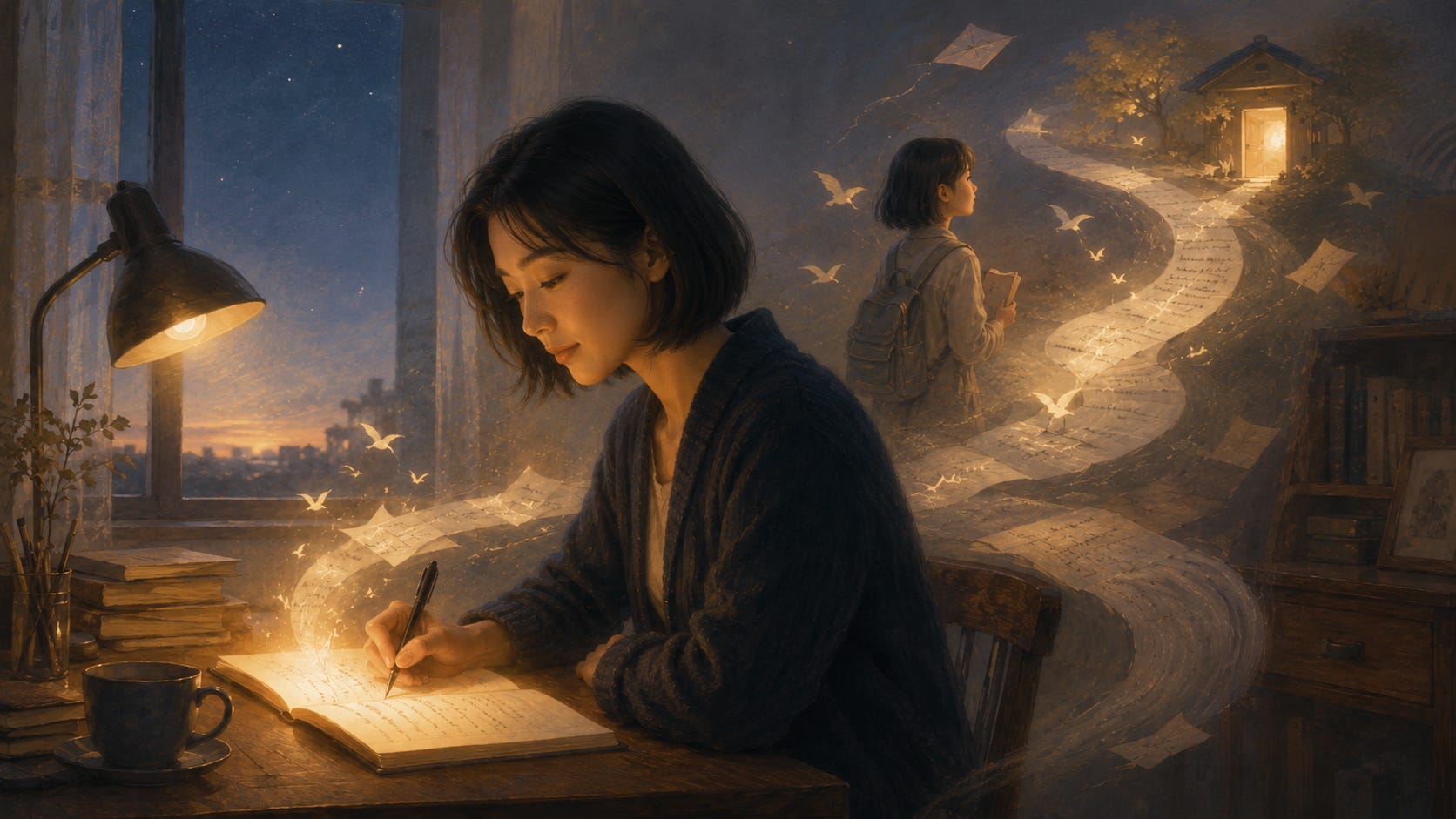
For fourteen years, I mistook not writing for having moved on.
I told myself a simpler story: that life had changed, that I had changed, that perhaps writing had belonged to an earlier version of me — a girl in another country, in another language, with notebooks full of sentences and a private, almost embarrassing faith in words.
After I came to America, I barely wrote a single real essay.
Fourteen years is a long silence. For someone who loved writing as a child, who once felt most alive when arranging the world into sentences, fourteen years can feel almost cruel.
From the outside, nothing appeared missing. I was living, after all. I studied. I worked. I learned to move through a new language and a new culture. I learned how to make a life in a country that did not yet feel like mine. I answered emails, paid bills, packed lunches, showed up on time, did the next necessary thing.
Day by day, I became competent at survival.
But somewhere underneath that competence, a part of me had been left behind.
She did not disappear.
She wandered.
Sometimes she was a kite with its string cut loose, drifting too far into the sky to be called back. Sometimes she was a small boat rocking in unfamiliar waters, longing for shore but unable to recognize a harbor.
For a long time, I avoided looking at her too closely.
I told myself: Maybe I simply don’t write anymore. Maybe it was an old love, and old loves are allowed to fade.
I tried to find other interests. But most things required effort in a way writing never had. I had to remind myself to continue them, to build habits around them, to convince myself they were good for me. Writing had never needed that kind of persuasion. I did not write because I was disciplined, or because someone praised me, or because I had something to prove.
I wrote because it felt as natural as breathing.
And yet, I had put it down.
I let work and life flood in until there was no room left to ask what had gone missing. The days were full. One task led to another. The current of ordinary responsibility carried me forward. I even comforted myself with the respectable facts of my life: stability, healthy children, meaningful work, a home, nothing dramatic to complain about.
But sometimes, late at night, when the house was quiet and the day had finally loosened its grip, a voice would rise from somewhere very deep inside me and ask:
Are you still here?
Fourteen years later, I finally decided to answer.
Or perhaps more accurately, I finally sat down and asked myself the question I had been avoiding for years:
Why did you stop writing?
At first, the answers came easily. They were reasonable. They were even true.
When I first arrived in the United States, I was living in survival mode. Every day required translation — not just of language, but of culture, expectations, humor, politeness, ambition, failure. I had to learn new academic rules, new professional rhythms, new ways of making friends, new ways of being understood. Even the most ordinary parts of daily life had to be figured out again.
Of course writing could wait.
I also told myself: My mother tongue is Chinese, but I live in America now. If I write in Chinese, who here will read me? If I write in English, how could I ever write with the precision, intimacy, and emotional texture I longed for?
So I stopped.
All of this was true.
But it was not the whole truth.
What kept me from writing was not only busyness, or language, or the imagined absence of readers.
There was something deeper, more private, curled up in a corner of my heart and pretending not to exist.
It was guilt.
And it was fear.
I felt guilty that when I took the gaokao, China’s college entrance exam, I listened to my parents, teachers, and other adults and chose law instead of literature.
I felt guilty that after four years of studying law, when I came to the United States for graduate school, I chose education instead of literature.
I worried that my Chinese was growing distant from me, year by year.
I worried that my ability to write had not merely paused, but weakened.
I worried that the longer I delayed, the farther I drifted from the girl who once wanted, secretly and fiercely, to become a writer.
And most of all, I was afraid of this: what if I finally picked up the pen again and discovered that I could no longer write?
So the more guilty I felt, the less I dared to write.
And the less I wrote, the more guilty I became.
The two fed each other like snakes biting each other’s tails, circling the same dark corner of my heart for fourteen years.
Looking back now, I don’t think I ever forgot writing.
I was simply too afraid to face the self I had set aside.
The child who glowed quietly when a teacher praised her essay.
The young girl who believed, without yet knowing why, that her life would always have something intimate to do with words.
The self I kept soothing through each practical decision: Not yet. Later. Someday.
She never blamed me.
But she never really left.
She sat there, waiting for me to turn around.
Before I returned to writing, I returned to reading.
At first, I did not think of reading as the beginning of my way back. I only knew I needed something quiet. Something that did not ask to be monetized, optimized, measured, or turned immediately into a result.
Slowly, reading pulled me out of the narrow room of my fear.
It reminded me that a life is not a single road chosen once and followed forever. We are allowed to stop. To wander. To take the long way around. To return. To arrive at another path at an hour that once seemed too late.
It also showed me that so much of what imprisons us is not reality itself, but the old stories we keep rehearsing in our minds.
You missed your chance.
It is too late to begin again.
You no longer have the right to call yourself someone who loves writing.
These voices sound like truth, but often they are only fear dressed in truth’s clothing.
Reading opened a window.
Through it, I saw that a person can speak again after a long silence. That one can drift away from a beloved thing in one season of life and return to it in another. That the choices we made in the past are not life sentences. They are simply roads we once walked.
Sometimes this realization arrives through a book.
Sometimes through a single sentence.
Sometimes through an ordinary conversation with a friend, a colleague, or someone we love.
It rarely announces itself with drama. More often, it touches your shoulder so lightly that you almost miss it. And then, suddenly, you remember:
Oh. I still have a choice.
When I began writing again, I was not graceful.
I felt like a machine left too long in the rain, suddenly asked to move. Every sentence creaked. Every thought arrived stiffly. My mind froze, restarted, froze again. I would write a few lines, feel embarrassed by them, delete them, begin again, and then wonder whether I had anything worth saying at all.
And yet, even inside that awkwardness, something in me was waking.
It was not exactly joy.
It was not triumph.
It was more like frozen ground beginning to crack. A small green shoot pushing through. Tender, uncertain, almost pitiful — but alive.
And once I saw it, I knew I could not press it back into the earth.
Now, I worry less about which language I write in.
I worry less about whether anyone reads.
Of course I still want to be read. Of course I still want to become better. But those desires are no longer the price I must pay before I am allowed to begin.
Writing, first of all, is my answer to an inner longing.
It is the way I return to myself.
It is also the way I meet the world more deeply.
Writing gives me a quiet room inside a noisy life. It allows me to gather the fleeting feelings, questions, observations, and aches that pass through me, and place them slowly on the page until I can see them clearly, understand them a little, and let them rest.
Years ago, I thought writing was a talent.
Later, I thought writing was a dream.
Now I think writing is a form of coming home.
Not home as a place on a map, but home as a self: the part of me not entirely worn smooth by responsibility, not entirely trained out of wonder, still willing to feel, to ask, to notice, to speak honestly.
I do not know where writing will take me this time.
Perhaps nowhere impressive. Perhaps the work will remain clumsy for a while, still rusty, still searching for its rhythm one sentence at a time.
But this time, I am not treating writing as an exam I am fourteen years late to take.
I am no longer standing at an old crossroads, punishing myself for not having chosen another road.
Fourteen years have passed.
And I finally understand that not everything delayed is lost.
Some loves are only buried for a while beneath the dust of living. If you are willing to kneel down and brush the dust away, slowly, tenderly, you may find they have been there all along.
So I am grateful to have picked up writing again.
Not because I have proven anything.
But because I have finally turned toward the self who waited for me for fourteen years and said:
I’m still here.
Let’s keep writing.
Reader conversation
Join the conversation
Share what this essay brought up for you—your experiences, questions, or a different perspective.