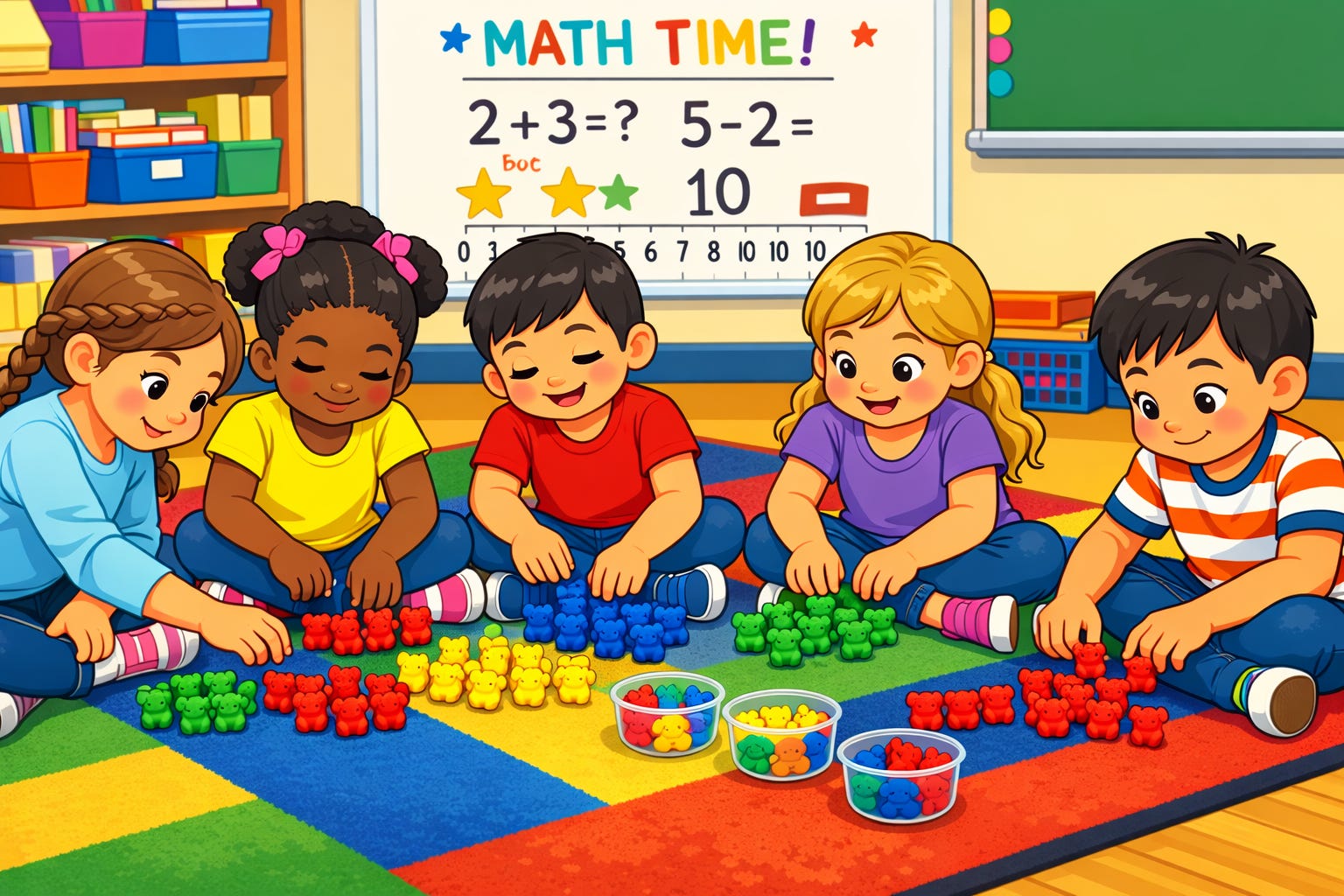
A few days ago in my first-grade math class, I improvised a little experiment on the spot. It worked surprisingly well—and it led us into a discussion that was both funny and actually kind of deep (yes, with six-year-olds… it happens).
That day’s goal was to practice counting a big, messy pile of objects by grouping them into tens. I decided—last minute—not to follow the textbook and instead run a whole-class, hands-on activity. I dumped a giant basket of math manipulatives—tiny plastic bears—right into the middle of our carpet area, then had everyone sit in a circle around the Bear Pile of Destiny and count how many bears there were.
I told them we were going to compare two methods we often use and see which one was more efficient. The “problem” I was trying to tackle was this: some students have an instinctive allergy to new math strategies. They’d rather use the one familiar method they already know for everything, even when a new method is clearly faster.
So we started with Method #1: counting one by one. We took turns picking up a bear and continuing the count from the previous person. At first everyone was excited. Then we hit 100… and the vibe changed.
Energy started leaking out of the room like air from a balloon. Some kids began casually building bear families with the bears they’d picked up and needed frequent reminders to rejoin the counting mission. On top of that, they had to count in their non-native language—Mandarin—which increased the brain fatigue and made focusing even harder.
And honestly? That was exactly what I wanted. Because nothing teaches “inefficiency” like living through it.
After about fifteen minutes (and a whole lot of cheerleading), we finally finished. The total was somewhere in the 200s. We briefly shared how that method felt, and the class unanimously agreed: if a math method takes forever, your brain gets tired, your attention falls apart, and you’re way more likely to make mistakes.
Then we moved on to Method #2: counting by tens. I poured all the bears back into the center, and everyone grabbed ten bears at a time and made little piles. We kept going until all the bears were in neat groups of ten, and the leftover bears that didn’t make a full ten sat off to the side like the “bonus bears.”
We finished grouping in under five minutes. The kids were delighted. Reviews included: “THIS IS SO FAST.” “WHY DIDN’T WE DO THIS FIRST?” (Same, honestly.)
But there was one last step: each student had to count the tens and write the final total on the whiteboard. They could write their name or stay anonymous. And this was the second “problem” I wanted to address: a lot of kids act like basic practice is beneath them. Like, “I already know this. Why are we still doing it?”
At first, everyone was super confident—counting by tens is a skill they’ve known for a while. So kids wrote answers at lightning speed, and the board filled up instantly… with a shocking variety of totals.
When the last kid finished, I asked them to look at all the answers and tell me what they noticed.
One student immediately said, very calmly, like a tiny detective:
“Even though we counted the same bears, everyone got different answers. That means either everyone is wrong… or most people are wrong.”
The room went quiet. Kids stared at the board, stared at their own answers, and did that panicked “Wait… what?” face while scratching their heads like confused little professors.
So I asked: “As a student, if your answer is wrong… is that a huge deal?”
Several kids answered right away:
“No, it’s okay to make mistakes.”
“Yeah, you can just fix it.”
“We’re still learning.”
I agreed—and I was genuinely happy they’ve absorbed that message. But then I added: “Okay. Now imagine you’re a scientist designing a spaceship that’s going to take astronauts to space. If your math is wrong… is that still not a big deal?”
The class went silent for a few seconds, and then someone blurted out:
“THAT’S A HUGE DEAL!”
“The spaceship will explode!”
“PEOPLE WILL DIE!!”
Listening to six-year-olds say this with the most dramatic, adorable seriousness was… deeply entertaining. And at that moment I knew: the experiment had done its job.
We wrapped up with this takeaway: sometimes even “easy” things are easy to mess up. Practice still matters. And doing it with a careful, serious attitude matters too.
In the end, we never actually figured out the true number of bears. But honestly, that number wasn’t the point anymore. I told them we could count again another day if they were curious.
Today, though, we were done—because the class had reached a unanimous conclusion:
We have counted… enough bears. 🐻
Reader conversation
Join the conversation
Share what this essay brought up for you—your experiences, questions, or a different perspective.