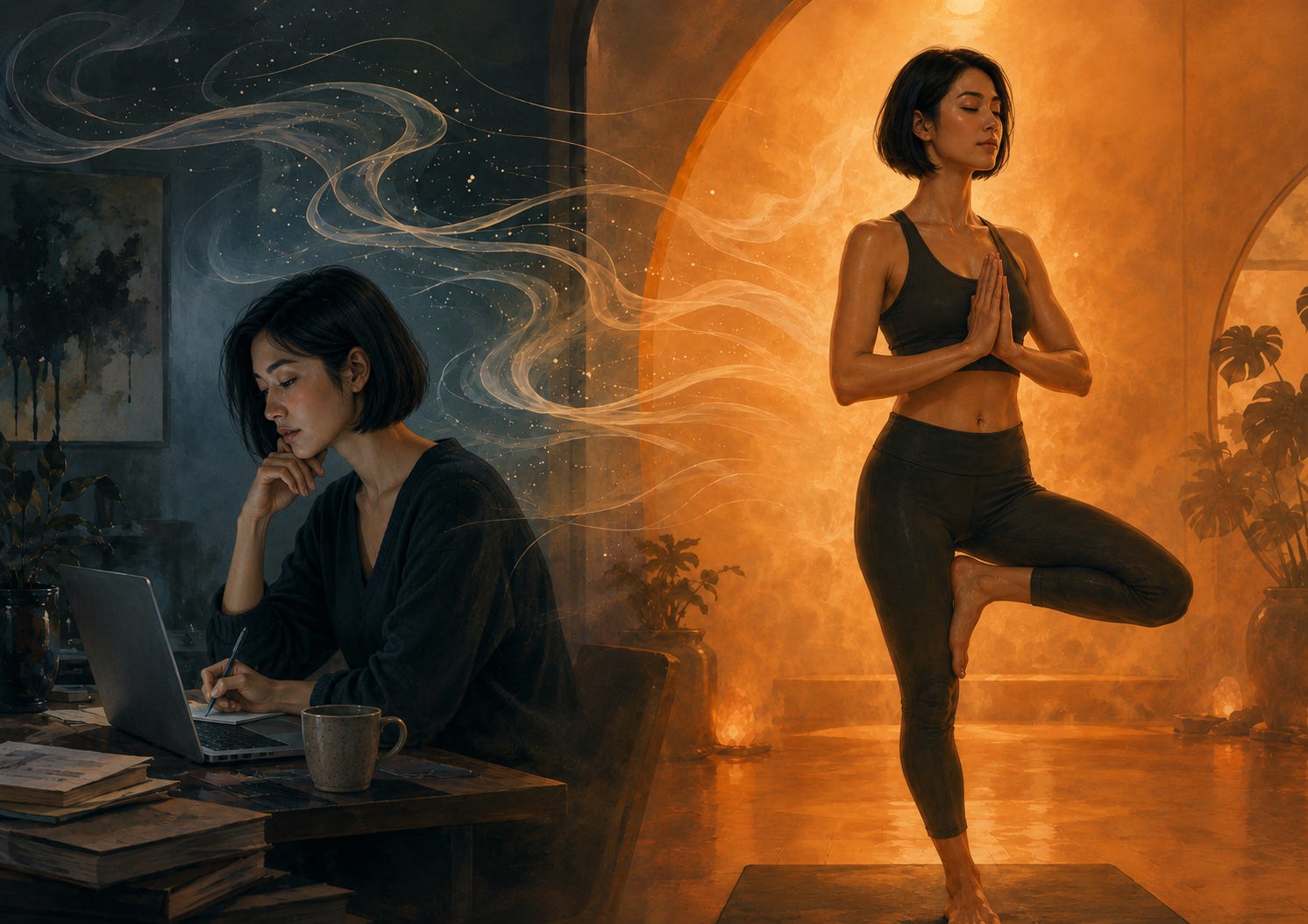
After two hours of writing, I don’t so much get up from my chair as return to it.
My mind is still lit from within. Sentences keep running. Characters linger in the doorway. A new idea, inconvenient and bright, is still tapping at the glass, asking to be let in.
But my body has gone quiet.
My shoulders are stiff. My eyes feel thin and dry from the screen. My feet are cold from sitting too long. My fingers, which moments ago were moving so quickly over the keyboard, have been doing the work of building an invisible world. The rest of me, meanwhile, has been left behind.
So I go to hot yoga.
This sounds, I know, like a sensible habit: movement after stillness, exercise after mental work, the tidy choreography of a well-managed life. But that isn’t what it feels like.
It feels like being called back.
From thought to breath.
From language to skin.
From the strange, godlike control of writing to the humbling fact of having ankles, knees, lungs, sweat.
For a while, when I write, I almost forget I have a body. Yoga reminds me. Not gently at first, perhaps — the room is 105 degrees, the air heavy as a warm towel — but faithfully. It returns me to the ground, one trembling muscle at a time.
When I write, the world narrows and expands at once.
The room fades: desk, cup, window, afternoon light. What becomes vivid is elsewhere — a face forming in the mind, a rhythm inside a sentence, the invisible pressure between two people who have not yet spoken. One line calls up the next. One thought collides with another. Ideas run loose, like horses without bridles.
For those two hours, my body is mostly a tool.
My fingers type. My eyes stare. Everything else is expected to be patient. Hunger can wait. Thirst can wait. The small ache in my back can wait. I am busy making order out of language.
There is a dangerous pleasure in this.
On the page, I can make someone speak or withhold speech. I can lift a memory into view, then bury it again. I can change one word and alter the weather of an entire paragraph. Writing gives me the illusion — intoxicating, impossible — that if I keep going long enough, the chaos of living might be arranged into something I can understand.
But the body is not impressed by literary control.
It waits. Quietly, stubbornly. And when I finally look up, it reports back in its own blunt language: cold feet, tight shoulders, dry eyes. You went very far, it says. But I was here the whole time.
Then I open the door to the hot yoga studio, and the heat comes over me like a damp towel.
The mind, still full of sentences, is suddenly interrupted. The air is thick with sweat and breath. Mats lie in neat rows. The room has none of the glamour of the imagination. It asks for something much simpler.
Stand here.
Breathe.
Stay.
The moment I step onto the mat, I lose my authority. There are no characters to direct, no scenes to revise, no paragraph I can polish into obedience. There is only my foot, my knee, my spine, my breath. There is my ankle, trembling in a balance pose, telling the truth about me.
I am no longer the person arranging a world.
I am only a person trying not to fall.
This humbles me every time. A half hour earlier, I was almost godlike, deciding who meets whom, where the wind blows, where a sentence should break. Now I am in front of a mirror, negotiating with my thighs and core as if with difficult relatives: please, just ten more seconds.
This is the brutal tenderness of hot yoga.
It will not let me remain abstract. It brings me back by force, but not unkindly. Sweat slides down my face and gathers at my chest. My muscles heat. My heart quickens. Breath becomes something I can no longer take for granted.
Press your hands down.
Root your feet.
Soften the shoulders.
Don’t lock the knees.
Don’t hold your breath.
The instructions are almost embarrassingly simple. That is why they work.
Writing sends my mind outward. It wants to gather, connect, interpret, name. It casts a net over every flicker of feeling, every shard of memory, every half-formed thought.
Yoga draws the net back in.
No explaining.
No analyzing.
No meaning-making.
No need to turn sensation into language.
Only this: my right foot on the mat. My arms shaking. Sweat on my eyelid. My breath, rough but present. The undeniable fact that if I do not breathe, I cannot stay.
And strangely, once the body becomes fully occupied, the mind begins to empty.
The unfinished sentences, the unsolved paragraphs, the questions of structure and meaning — they loosen in the heat. They are not resolved. I have not conquered them. They have simply stopped asking for me.
Sometimes, halfway through class, I realize that quiet does not always come from stillness. Sometimes it comes from a more complete attention.
When the body wakes up, the mind is allowed to rest.
That is the strange balance I keep returning to.
In writing, the mind runs and the body sleeps.
In yoga, the body burns and the mind goes clear.
One carries me away.
The other brings me back.
One gives me language.
The other returns me to what existed before language: breath, pulse, weight, heat, skin.
I used to think rest meant stopping. Not writing. Not thinking. Lying down. Scrolling. Disappearing into some mild, blue-lit numbness.
But for someone who lives too easily in her head, real rest is often not stillness. It is another way of waking.
Let the body wake, and the mind can finally loosen its grip.
Let the sweat come, and the thoughts untangle a little.
Let the feet meet the ground, and the self stops floating quite so far from home.
So hot yoga after writing is not just exercise. It is not even recovery, exactly.
It is a summons.
A firm and merciful calling-back of the self that has flown too far into words.
It asks me to feel the soles of my feet, the tremor in my muscles, the simple labor of breathing. It reminds me that I do not have to spend my whole life creating, explaining, arranging, controlling.
Sometimes, when I leave the studio, I am still carrying the heat. My hair is wet against my face. My clothes cling to me. I feel rinsed from the inside.
Then the outside air touches my skin, and for a moment I feel strangely light.
Not because anything has been solved.
Not because inspiration has returned.
But because I have returned.
I am not making anything.
I am not proving anything.
I am only walking, breathing, carrying a quieter mind inside a body I have finally remembered.
Reader conversation
Join the conversation
Share what this essay brought up for you—your experiences, questions, or a different perspective.